
The Evolution of California Dementia Care Infrastructure and Support Systems
The landscape of dementia support in the Golden State has undergone historic shifts. Modernized regulations under Title 22 that took effect in 2025 reshaped how Residential Care Facilities for the Elderly (RCFEs) approach memory support. Historically, regulations applied broad, rigid restrictions across anyone diagnosed with cognitive decline. Today, the state mandates individualized appraisals, person-first language, and tailored care plans designed to keep seniors in the least restrictive environment possible.
Under updated guidelines from the California Department of Social Services dementia care information repository, care communities no longer enforce blanket restrictions on items like personal grooming tools or everyday items. Instead, licensed medical professionals evaluate each resident using modernized assessment forms (such as LIC 602A). These assessments focus on real-world behavioral expressions and baseline functioning rather than a generic diagnostic label.
Facilities must balance safety with personal dignity. Environmental standards require slip-resistant bathroom flooring, transparent admission policies regarding item retention under California Health and Safety Code section 1569.282, and intentional physical layouts that reduce anxiety rather than feeling institutional.
Accessing Specialized California Dementia Care Programs and State Resources
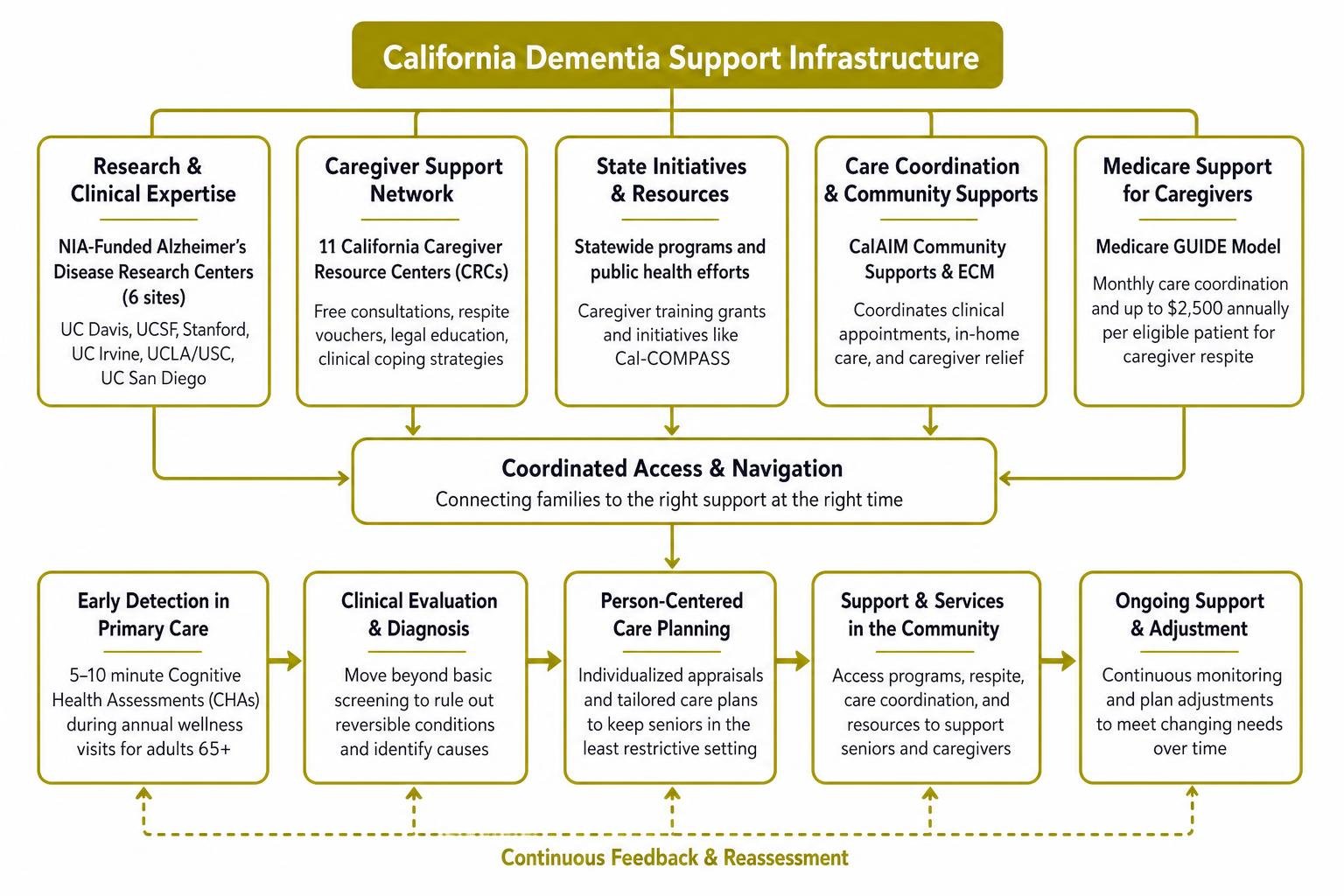
California boasts one of the most comprehensive public dementia support systems in the nation. Navigating it requires understanding how federal, state, and regional networks connect:
- NIA-Funded Alzheimer’s Disease Research Centers (ADRCs): California is home to 6 elite National Institute on Aging research hubs—located at UC Davis, UCSF, Stanford, UC Irvine, UCLA/USC, and UC San Diego—providing access to advanced diagnostics, novel clinical trials, and specialized multidisciplinary consultations.
- 11 California Caregiver Resource Centers (CRCs): Established as the first state-funded caregiver network in the nation, CRCs offer free family consultations, localized respite vouchers, legal education, and clinical coping strategies.
- State Initiatives: Comprehensive statewide programs, accessible via State Alzheimer’s and dementia support resources, coordinate public health efforts, caregiver training grants, and pilot initiatives like Cal-COMPASS to delay institutionalization.
- CalAIM Community Supports & ECM: Medi-Cal’s enhanced care management helps vulnerable seniors coordinate clinical appointments, in-home personal care, and caregiver relief.
- The Medicare GUIDE Model: The Guiding an Improved Dementia Experience model delivers per-beneficiary monthly care coordination and up to $2,500 annually per eligible patient for caregiver respite services.
Clinical Detection and Primary Care Diagnostic Workflows
Early detection alters the entire trajectory of care. Through statewide programs like Dementia Care Aware, primary care physicians across California now incorporate 5- to 10-minute Cognitive Health Assessments (CHAs) into routine annual wellness visits for adults aged 65 and older.
When cognitive concerns emerge, clinicians move beyond basic bedside mental exams to rule out reversible conditions and pinpoint specific etiologies:
- Biomarker & Neuroimaging Diagnostics: High-resolution brain MRIs, CT scans, and advanced blood biomarker assays detect amyloid and tau pathology.
- Comprehensive Neuropsychological Testing: Standardized evaluations measure memory, processing speed, executive function, and language recall against peer baselines of identical age and education levels.
- Novel Disease-Modifying Therapies: For candidates in early stages of Alzheimer’s disease, treatments like lecanemab (Leqembi) help clear amyloid plaques to slow clinical progression when paired with rigorous health monitoring.
- Multidisciplinary Care Coordination: Neurologists, licensed clinical social workers, occupational therapists, and speech pathologists collaborate to formulate continuous, stage-specific support plans.
Navigating Legal Preparedness and Essential Planning in California
Proactive legal planning is critical when cognitive capacity begins to fluctuate. Executing paperwork early ensures an individual’s personal wishes, medical preferences, and financial assets remain protected under state law without requiring stressful court interventions later.
California families should complete what elder law specialists refer to as the “California Legal Quartet”:
- Advance Health Care Directive (AHCD): Governed by California Probate Code §§ 4670–4806, this document designates a healthcare agent and outlines medical intervention desires, palliative care instructions, and end-of-life choices.
- Durable Power of Attorney for Finances (DPOA): Under California Probate Code §§ 4000–4545, a DPOA grants a trusted person authority to manage bank accounts, pay bills, handle real estate, and navigate public benefits without disruption.
- Physician Orders for Life-Sustaining Treatment (POLST): Signed by both the individual (or their legally appointed surrogate) and a physician under Health & Safety Code §§ 4780–4786, this translates medical wishes into actionable, immediately enforceable medical orders across emergency responders.
- Nomination of Conservator: Under Probate Code § 1810, this specifies who should be appointed if a court conservatorship ever becomes necessary, preventing contentious family disputes.
Families should also understand California Health & Safety Code § 103900, which establishes mandatory physician reporting for patients diagnosed with disorders characterized by lapses of consciousness or cognitive impairment that impair safe driving. This requires the California Department of Motor Vehicles to conduct an administrative driving evaluation rather than placing the burden of license surrender solely onto family members.
Implementing a 30-Day California Dementia Care Roadmap
The first month following a diagnosis can feel overwhelming. Following a structured roadmap, such as this operational California dementia care roadmap, breaks complex planning down into manageable, weekly milestones:
- Week 1 (Diagnostic Confirmation): Rule out reversible mimics (such as vitamin B12 deficiencies, normal-pressure hydrocephalus, thyroid dysfunction, or untreated sleep apnea). Connect with the Alzheimer’s Association 24/7 Helpline (1-800-272-3900) and your local Caregiver Resource Center.
- Week 2 (Legal & Medical Optimization): Execute the California Legal Quartet while decision-making capacity remains intact. Consult a neurologist regarding candidacy for disease-modifying therapies or speech and occupational therapy.
- Week 3 (Benefits & Financial Review): Evaluate long-term care insurance policies, VA benefits (such as Aid and Attendance), and public options including In-Home Supportive Services (IHSS) and Medi-Cal Long-Term Care.
- Week 4 (Support Architecture & Staging): Formulate a caregiver respite plan. Map functional capabilities using clinical staging tools like the Functional Assessment Staging Tool (FAST) to anticipate when in-home support or specialized residential care will be needed.
Regional Costs and Public Financing for California Memory Care

Residential memory care provides 24-hour secured perimeters, high staff-to-resident ratios (typically 1:5 or 1:6 compared to 1:10+ in standard assisted living), medication management, specialized sensory architecture, and structured cognitive programming.
Families exploring our comprehensive memory care services often discover that total monthly costs comprise a base residential rate plus acuity add-on tiers based on personalized care requirements (such as two-person transfer assistance, incontinence management, or intensive behavioral cues):
| California Region | Average Monthly Base Range (2026) | Typical Acuity Add-Ons | All-In Monthly Estimate |
|---|---|---|---|
| San Francisco Bay Area / Silicon Valley | $9,500 – $11,500 | $800 – $2,500 | $10,300 – $13,500+ |
| West Los Angeles / Coastal Southern CA | $9,000 – $11,000 | $750 – $2,200 | $9,750 – $12,800 |
| Orange County & San Diego | $8,500 – $10,500 | $600 – $2,000 | $9,100 – $12,000 |
| Sacramento Metro | $7,500 – $9,500 | $500 – $1,800 | $8,000 – $11,000 |
| Inland Empire | $7,000 – $9,000 | $500 – $1,500 | $7,500 – $10,200 |
| Central Valley | $6,500 – $8,500 | $450 – $1,400 | $6,950 – $9,500 |
Public Coverage Breakdown: Medi-Cal, IHSS, and Medicare Rules
Understanding who pays for what prevents costly assumptions:
- Medicare: Covers outpatient clinical visits, diagnostic imaging, lab work, home health therapy with a skilled medical need, and end-of-life hospice care. Medicare pays zero dollars toward residential memory care room, board, or long-term custodial supervision.
- Medi-Cal Long-Term Care & Asset Limits: Under California Assembly Bill 116, the Medi-Cal asset limit was reinstated on January 1, 2026, at $130,000 for an individual and $195,000 for a married couple. These limits remain in place through June 30, 2027, after which they are scheduled to reduce to $21,000 (single) and $31,000 (couple). California enforces a 30-month look-back period (rather than the federal 60-month window). Notably, any asset transfers made between January 1, 2024, and December 31, 2025, carry no disqualification penalty.
- Assisted Living Waiver (ALW): For seniors who qualify financially, public funding options outlined in this guide to Medi-Cal coverage for memory care explain how the ALW covers care service costs within participating RCFEs across 15 California counties, though the resident must still pay room and board from SSI or personal income.
- IHSS Protective Supervision: For individuals remaining at home, Medi-Cal’s In-Home Supportive Services provides up to 283 hours per month of paid supervision to protect non-self-directing individuals from injury, wandering, or hazards.
Person-Centered Therapeutic Environments and Cognitive Engagement

Creating an environment tailored to cognitive challenges goes far beyond basic custodial supervision. It involves building a daily rhythm that stimulates neuroplasticity, preserves personal identity, and fosters deep emotional well-being.
At Villa Toscana Memory Care in Mountain View, our family-owned, boutique environment integrates secure indoor and outdoor walking paths, natural lighting, and specialized culinary programming through our on-site partnership with Giorgio’s Italian Grill. Providing scratch-made, nutritious meals in a warm, restaurant-style atmosphere transforms daily dining into a comforting, social highlight.
Maintaining comprehensive health and wellness requires daily opportunities for meaningful expression. Implementing purposeful, evidence-based stimulating memory loss activities—such as therapeutic music sessions, tactile gardening, reminiscence circles, and sensory art—helps residents maintain cognitive pathways, reduces evening agitation (sundowning), and fosters genuine joy.
Frequently Asked Questions about California Dementia Care
Can Medi-Cal pay for residential memory care in California?
Conditionally. Medi-Cal does not offer an all-inclusive residential memory care entitlement. However, qualifying individuals can use the Assisted Living Waiver (ALW) to cover personal care service fees in licensed RCFE memory care units that hold specific CDSS secured-perimeter approvals across 15 participating California counties. The resident remains responsible for their monthly room and board fee using Social Security or private funds. When medical needs reach skilled nursing criteria, Medi-Cal covers 100% of care in certified skilled nursing facilities.
How do California’s 2026 Medi-Cal asset rules affect long-term dementia care?
Under AB 116, California reinstated non-exempt asset limits on January 1, 2026, set at $130,000 for a single applicant and $195,000 for a couple. These thresholds remain active through June 30, 2027. Primary residences, one vehicle, and personal effects remain exempt. Furthermore, California utilizes a 30-month look-back review for asset transfers, though any transfers executed during the 2024–2025 calendar years carry zero penalties.
Can family members and spouses get paid as caregivers in California?
Yes. Under California’s In-Home Supportive Services (IHSS) program, family members can become paid care providers. Furthermore, through the IHSS-Plus Option under federal § 1915(j) authority, California is one of the few states that legally allows spouses to receive hourly compensation for providing personal care and Protective Supervision (up to 283 monthly hours) to an impaired partner.
Conclusion
The evolving landscape of dementia care in California empowers families with stronger legal protections, improved clinical diagnostic models, and person-centered residential standards. Proactive planning—from early cognitive screening and executing the California Legal Quartet to mapping long-term financial resources—ensures your loved one receives the dignity, safety, and enriching lifestyle they deserve.
When home care is no longer safe or sustainable, choosing an intentionally designed, boutique community makes all the difference. We invite you to discover how our compassionate team, award-winning architectural environment, and culinary excellence support families every day at Villa Toscana Memory Care.