
Is Memory Care Considered Skilled Nursing? The Core Differences
When evaluating whether is memory care considered skilled nursing, it helps to understand how these two care environments differ fundamentally in purpose, licensing, and daily care philosophy. Families often assume any facility with 24-hour supervision is a “nursing home,” but the operational models could not be more distinct.
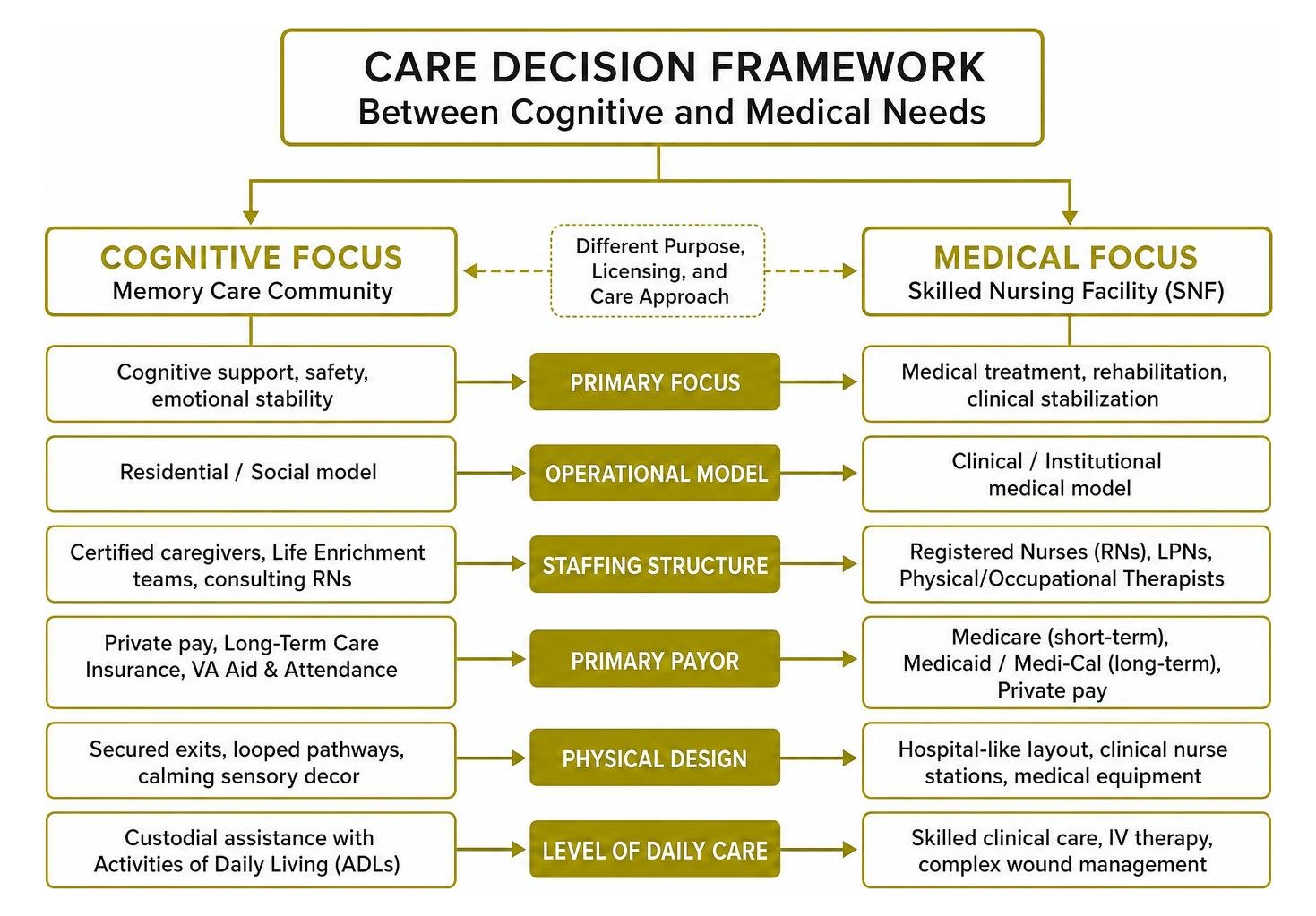
A thorough legal analysis of care classifications highlights that memory care is built on a social and residential model focused on cognitive preservation, whereas skilled nursing facilities (SNFs) operate as clinical medical institutions.
| Feature / Metric | Memory Care Community | Skilled Nursing Facility (SNF) |
|---|---|---|
| Primary Focus | Cognitive support, safety, emotional stability | Medical treatment, rehabilitation, clinical stabilization |
| Operational Model | Residential / Social model | Clinical / Institutional medical model |
| Average National Cost (2026) | ~$6,450 to $6,935 / month | Semi-Private: ~$9,277 / month Private: ~$10,646 / month |
| Staffing Structure | Certified caregivers, Life Enrichment teams, consulting RNs | Registered Nurses (RNs), LPNs, Physical/Occupational Therapists |
| Primary Payor | Private pay, Long-Term Care Insurance, VA Aid & Attendance | Medicare (short-term), Medicaid / Medi-Cal (long-term), Private pay |
| Physical Design | Secured exits, looped pathways, calming sensory decor | Hospital-like layout, clinical nurse stations, medical equipment |
| Level of Daily Care | Custodial assistance with Activities of Daily Living (ADLs) | Skilled clinical care, IV therapy, complex wound management |
Legal Classifications: Is Memory Care Considered Skilled Nursing Under State Regulations?
From a legal and regulatory standpoint, the answer remains an unequivocal no. Memory care communities are licensed and regulated primarily at the state level under assisted living frameworks. For example, in California, memory care operates within Residential Care Facilities for the Elderly (RCFE) licensing. These state regulations govern building safety, secured perimeter requirements, dementia-specific staff training hours, and resident rights, but they do not classify the setting as a medical institution.
Skilled nursing facilities, by contrast, must comply with strict federal oversight administered by the Centers for Medicare & Medicaid Services (CMS) under Title 18 (Medicare) and Title 19 (Medicaid) of the Social Security Act. SNFs are subject to rigorous federal life safety codes, unannounced federal health inspections, strict pharmacy standards, and public ratings on Medicare’s Care Compare portal. While state assisted living regulations vary widely across jurisdictions, federal SNF regulations establish uniform nationwide clinical standards.
Clinical Oversight: Is Memory Care Considered Skilled Nursing for Complex Medical Needs?
A major point of confusion for families is clinical staffing. Memory care communities excel at delivering compassionate dementia care support that manages behavioral expressions, provides medication administration, and delivers personal assistance. However, they are not designed to serve as full-time medical clinics.
In memory care, medication management and daily assistance are provided according to physician orders, but the on-site team is composed primarily of certified caregivers and medication technicians, backed by nurse oversight. Skilled nursing facilities must maintain licensed nurses—either a Registered Nurse (RN) or a Licensed Practical Nurse (LPN)—on duty around the clock to perform invasive clinical procedures, manage unstable chronic conditions, and evaluate acute changes in condition.
Comparing Daily Environments, Staffing, and Care Approaches
The physical atmosphere and daily rhythm in these two settings reflect their differing priorities. Walking into an SNF feels very much like walking into a sub-acute hospital wing. You will see clinical charting stations, medication carts lining the hallways, and physical therapy gyms equipped for rigorous rehabilitation.
In a dedicated memory care community like Villa Toscana Memory Care, the focus is creating a warm, dignified, and home-like atmosphere. Instead of stark clinical lighting and echoing tile, our setting incorporates secure courtyards, comforting interior palettes, and purposeful spaces that reduce anxiety and encourage independence.
Cognitive Engagement and Dementia Support
Memory care is engineered around the neuropsychiatric needs of individuals living with Alzheimer’s, vascular dementia, Lewy body dementia, and frontotemporal dementia. Because safety and disorientation are paramount concerns, our environment incorporates:
- Secured perimeters and smart monitoring: Preventing unsafe wandering while allowing residents the freedom to explore beautiful indoor and outdoor areas.
- Sensory and architectural design: Continuous looped walking paths without dead ends, color-coded neighborhood zones, and memory boxes outside suites to assist with orientation.
- Dignified, specialized dining: Programs like our on-site culinary partnership with Giorgio’s Italian Grill provide delicious, nutrient-dense meals in a calm, social setting that encourages hydration and appetite.
- Tailored life enrichment: Structured, stimulating activities for seniors with memory loss that tap into long-term memory, such as music therapy, tactile art, and reminiscence discussions.

Clinical Capabilities and Sub-Acute Rehabilitation
Skilled nursing facilities are purpose-built to handle clinical instability and rigorous physical restoration. Their services are centered around treatments that legally require the direct hand of a licensed medical professional.
Common clinical procedures and therapies managed within skilled nursing include:
- Complex stage 3 and stage 4 wound management and surgical site dressings
- Intravenous (IV) therapy, central line maintenance, and parenteral nutrition
- Tracheostomy care, daily respiratory therapy, and mechanical suctioning
- Enteral feeding tube management (G-tubes, J-tubes)
- Intensive sub-acute physical, occupational, and speech rehabilitation following a stroke, joint replacement, or major fracture
- Frequent vital sign titration for unstable cardiac or diabetic conditions
Cost Breakdown, Payment Options, and Transitions
Understanding long-term care finances is often one of the biggest hurdles families encounter. The pricing structures reflect the fundamental difference in staffing: memory care covers housing, dining, and intensive caregiver supervision, while skilled nursing incorporates extensive round-the-clock medical personnel and specialized equipment.
Across the United States in 2026, memory care averages between $6,450 and $6,935 per month (or roughly $83,220 annually), though high-cost metro areas can range higher. By comparison, a nursing home averages $9,277 per month for a semi-private room and $10,646 per month ($299 per day, or roughly $109,000 annually) for a private room.
Regional cost variations also play a significant role. For instance, in Arkansas, assisted living and memory care run around $4,562 monthly while private nursing home rooms average $8,060. In Massachusetts, semi-private nursing home rooms average $12,000 to $12,200 per month, with private rooms reaching $14,000 monthly.
Medicare, Medicaid, and Financial Planning
The way care is paid for differs drastically between the two settings:
- Medicare: Medicare Part A does not cover long-term custodial memory care or room-and-board. It only covers post-acute skilled nursing stays following a qualifying 3-day inpatient hospital stay. For eligible SNF stays in 2026:
- Days 1–20: $0 copay per day.
- Days 21–100: $217 per day coinsurance.
- Day 101 and beyond: $0 coverage (all costs are out-of-pocket or covered by Medicaid).
- Medicaid: Medicaid is the primary payor for long-term skilled nursing care for individuals who meet clinical criteria and state asset thresholds (such as the standard 2026 limit of $2,000 in countable assets for a single applicant). While Medicaid covers nursing home room and board, it rarely covers room and board in memory care, though state waiver programs or community-based grants may help offset personal care services.
- Private Funding & Alternative Support: Families funding memory care typically utilize private savings, proceeds from a home sale, long-term care insurance policies, or VA Aid and Attendance pensions. Families can also utilize short-term respite care to evaluate a community or give primary caregivers a temporary, much-needed break.
When to Transition From Memory Care to Skilled Nursing
Most residents with dementia can comfortably remain in memory care throughout the moderate and late stages of the disease. However, a transition to a skilled nursing facility may become clinically necessary if physical health deteriorates beyond what residential care licensing permits.
Key transition triggers include:
- Loss of physical mobility: Becoming entirely bedbound and requiring mechanical Hoyer lifts or two-person transfers that exceed residential community staffing capabilities.
- Complex nutritional needs: Developing severe dysphagia requiring surgical feeding tube maintenance.
- Advanced medical complications: The emergence of non-healing surgical wounds, unmanageable diabetes requiring frequent nurse intervention, or recurrent aspiration pneumonia requiring respiratory suctioning.
- Frequent hospital readmissions: When recurring acute medical crises cannot safely be stabilized within a residential environment.
Frequently Asked Questions About Senior Care Options
Can a skilled nursing facility provide memory care services?
Yes. Approximately 15% of nursing homes operate dedicated, secure dementia special care units. These units combine the clinical oversight and 24-hour RN staffing of an SNF with secured doors and specialized behavioral programming to safely accommodate residents who have both complex medical needs and progressive dementia.
Does Medicare pay for long-term memory care?
No. Medicare does not cover room, board, or custodial care in memory care communities or assisted living residences. Medicare only pays for medically necessary doctor visits, covered prescription medications (under Part D), hospice services, or short-term rehabilitative therapies ordered by a physician.
What triggers the move from memory care to a skilled nursing facility?
The move is triggered by acute medical instability rather than cognitive decline alone. When a senior requires ongoing treatments that only a licensed nurse can perform—such as complex IV therapy, intensive stage 3 or 4 wound management, daily respiratory support, or complete total-dependence bedbound care—state regulations typically require placement in a licensed skilled nursing facility.
Conclusion
Deciding between memory care and skilled nursing comes down to identifying whether your loved one primarily requires compassionate cognitive safety or intensive, around-the-clock medical treatment. Memory care provides an enriching, secure environment where individuals with Alzheimer’s and dementia can enjoy dignity, social engagement, and personalized daily support. Skilled nursing delivers the clinical horsepower needed to stabilize complex illnesses and acute physical injuries.
At Villa Toscana Memory Care, we believe in honoring each individual’s journey with tailored dementia care, innovative design, and life-enriching culinary and social programs. If you are navigating senior care decisions for your family, reach out to our team today to schedule a tour and discover how our specialized memory care community can support your loved one.