
Is the Memory Care Premium Worth Paying?
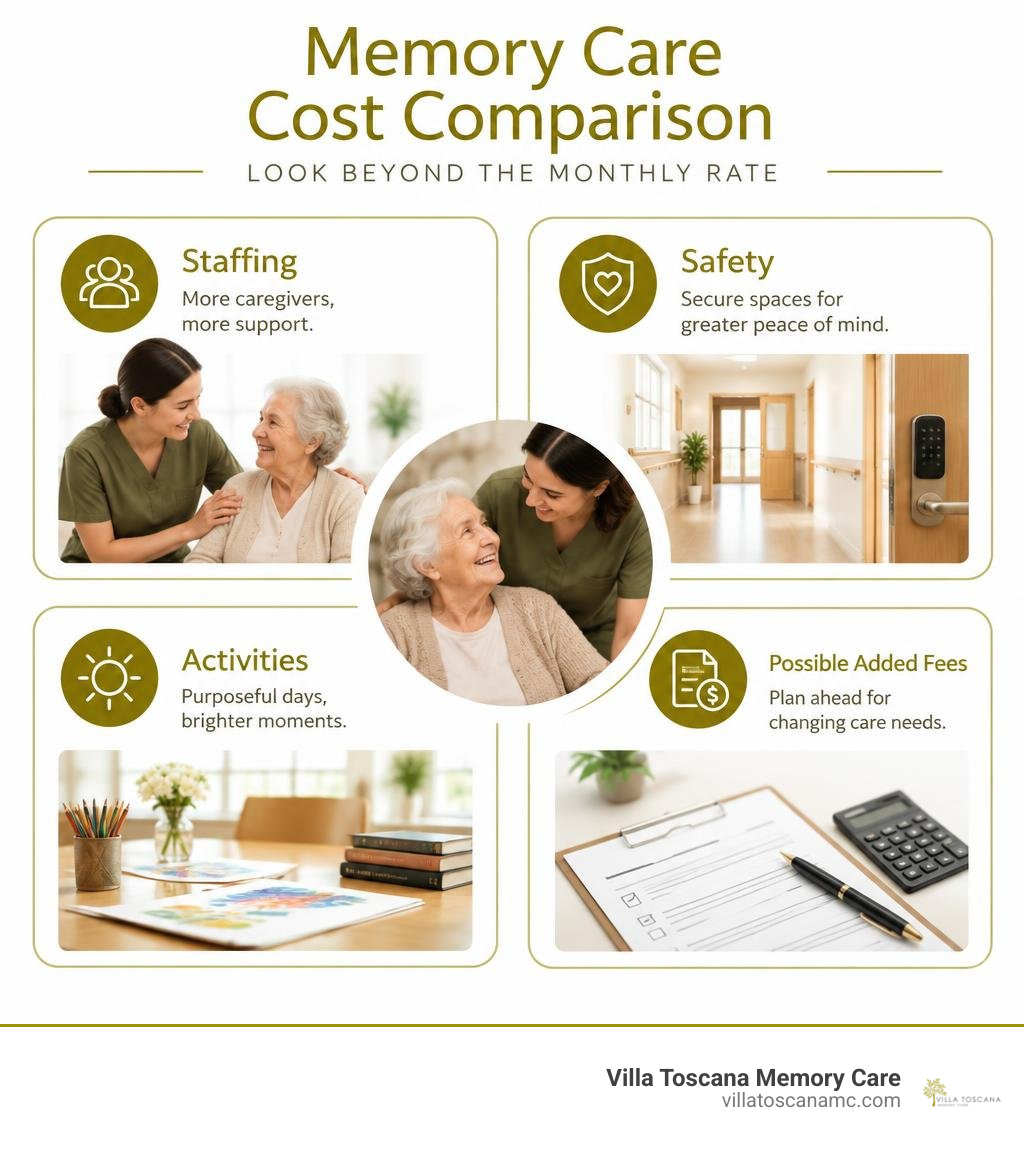
Compare more than the monthly rate. Memory care often costs 20% to 25% more than assisted living because it typically has more caregivers per resident, dementia-specific training, secured spaces, and structured activities. To judge whether that premium is worth it, ask each community for its day and night staffing levels, a recent activity schedule, and an itemized quote that shows how fees could rise as care needs change. When evaluating essential memory care cost comparison factors, staffing ratios and activities provide the clearest insight into the value of specialized support.
For a parent who is at risk of wandering or needs frequent redirection, those added supports may be essential. Someone with early-stage dementia who remains safe with less supervision may do well in assisted living. The right choice is the one that meets your parent’s needs now and fits a realistic long-term budget.
Explore our guides on dementia care for veterans, the key responsibilities of a memory care activities director, and choosing the right staffing ratio for memory care.
Baseline Costs: Memory Care vs. Assisted Living and Skilled Nursing
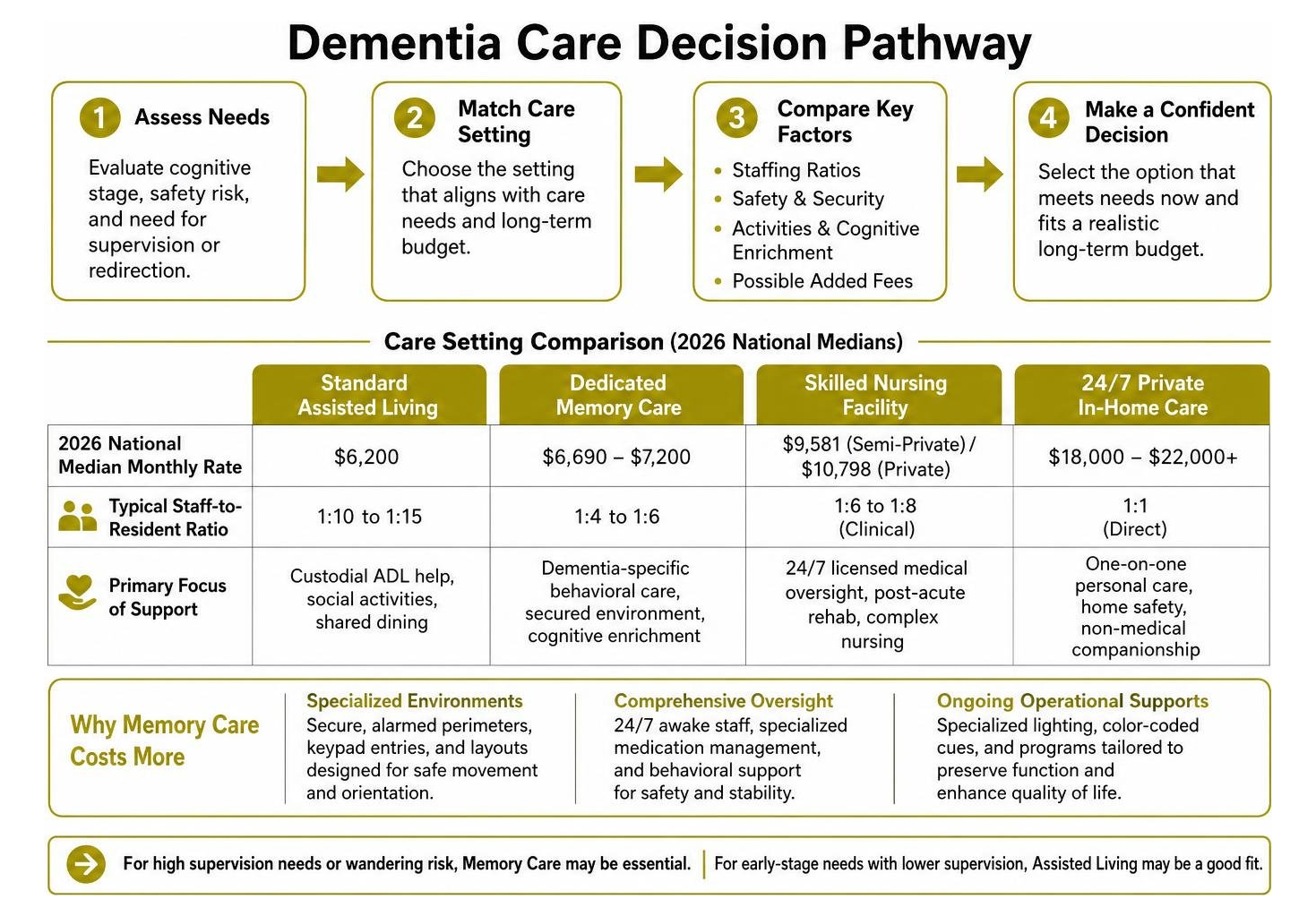
When researching long-term support for a loved one with Alzheimer’s disease or other forms of dementia, the financial fog can feel overwhelming. Understanding the financial landscape begins with comparing the fundamental settings available to older adults across the country. In 2026, the national median monthly cost for standard assisted living sits around $6,200. In contrast, dedicated memory care averages roughly $6,690 to $7,000 per month nationally, representing a clear pricing tier above traditional custodial living.
Families navigating assisted living vs memory care facilities often wonder why this price gap exists. As explored in analyses like Why Memory Care Costs More Than Assisted Living · Gale, this price difference is not arbitrary profit. Memory care operates on an entirely distinct operational model designed around acute cognitive vulnerability, constant supervision, and structured physical environments.
To put these numbers into context, we must also look at skilled nursing facilities and around-the-clock home care. While assisted living and memory care provide custodial care—help with activities of daily living (ADLs) like dressing, bathing, dining, and mobility—skilled nursing provides intensive clinical medical care. Meanwhile, attempting to hire 24/7 private duty caregivers at home can quickly reach staggering sums.
| Care Setting | 2026 National Median Monthly Rate | Typical Staff-to-Resident Ratio | Primary Focus of Support |
|---|---|---|---|
| Standard Assisted Living | $6,200 | 1:10 to 1:15 | Custodial ADL help, social activities, shared dining |
| Dedicated Memory Care | $6,690 – $7,200 | 1:4 to 1:6 | Dementia-specific behavioral care, secured environment, cognitive enrichment |
| Skilled Nursing Facility | $9,581 (Semi-Private) / $10,798 (Private) | 1:6 to 1:8 (Clinical) | 24/7 licensed medical oversight, post-acute rehab, complex nursing |
| 24/7 Private In-Home Care | $18,000 – $22,000+ | 1:1 (Direct) | One-on-one personal care, home safety, non-medical companionship |
The 20% to 25% Premium Explained
The 20% to 25% premium that memory care commands over assisted living tracks three mandatory operational realities: specialized physical plant designs, comprehensive behavioral oversight, and continuous direct-care presence. Examining average dementia care costs reveals that base rates cover significantly more overhead than standard senior housing.
First, memory care communities require architectural layouts built for safety: secure, alarmed perimeters, keypad-controlled entries, and continuous looping hallways that allow safe movement without dead ends that cause distress. Second, operational overhead includes round-the-clock awake staff, specialized medication management systems designed for memory loss, and environmental modifications such as specialized lighting and color-coded visual cues that preserve orientation.
Custodial Dementia Care vs. Medical Skilled Nursing
It is crucial to distinguish between residential memory care and skilled nursing. Families evaluating memory care vs skilled nursing should note that skilled nursing centers focus on medical clinical needs—such as tube feedings, complex wound management, intravenous therapy, and intensive physical rehabilitation.
Memory care is purpose-built custodial care tailored for progressive cognitive decline. In a skilled nursing facility, monthly rates often exceed $9,581 to $10,798 because the operational budget supports registered nurses (RNs) and physical therapists on every shift. If your parent does not require invasive medical procedures but requires cueing, fall prevention, cue-based dining, and behavioral redirection, memory care provides a dignified, residential setting at a substantially lower cost than a clinical nursing hospital bed.
Memory Care Cost Comparison Factors: Staffing Ratios, Activities, and Specialized Care

When analyzing the core drivers of specialized senior living, understanding key memory care cost comparison factors like staffing ratios and activities helps families determine if higher monthly rates translate into meaningful daily benefits. Direct care density and dementia-specific employee training form the single largest portion of any memory care operating budget.
Caregivers in dedicated communities do not simply assist with clothing and hygiene; they are trained in specialized dementia philosophies. This includes validated communication strategies, gentle de-escalation protocols for afternoon confusion, and redirection tactics for sundowning management. When a resident experiences disorientation or visual hallucinations, a trained caregiver knows how to enter their reality with empathy rather than arguing, avoiding distress and reducing the need for psychotropic medications.
Staff-to-Resident Ratios: 1:5 vs. 1:15 in Standard Senior Living
The most significant operational expense in memory care is the staff-to-resident ratio. In a traditional assisted living community, one caregiver may oversee 10 to 15 residents during the day, and up to 25 at night. In memory care, that ratio drops dramatically to 1:4, 1:5, or 1:6 during peak daytime hours, and maintains dedicated awake staff overnight.
Understanding state regulations regarding staffing ratios and state mandates shows why this density is critical:
- Rapid Fall Intervention: Caregivers notice subtle changes in gait or unassisted transfer attempts before an accident occurs.
- Proactive Behavioral Redirection: Early signs of anxiety or agitation are addressed through soothing engagement before escalating into severe distress.
- Overnight Monitoring: Residents who wake up confused or attempt to wander at 2:00 AM receive immediate, compassionate guidance back to rest.
- Caregiver Well-Being: Lower ratios prevent staff exhaustion and burnout, resulting in consistent, familiar faces caring for your loved one.
Memory Care Cost Comparison Factors: Staffing Ratios, Activities, and Therapeutic Engagement
Meaningful life enrichment in memory care looks vastly different from the card games or lecture series of standard retirement communities. Cognitive decline requires structured, therapeutic programming tailored to individualized neurological abilities. Providing stimulating activities for seniors with memory loss demands dedicated professionals, individual supplies, and continuous engagement throughout the morning and afternoon.
A qualified memory care activities director implements evidence-based enrichment modalities, such as:
- Sensory and Music Therapy: Evoking deep emotional memories and calming anxiety through personalized auditory and tactile stimulation.
- Reminiscence and Life Story Work: Utilizing visual memory boxes, familiar historical artifacts, and guided reflection to anchor personal identity.
- Cognitive Stimulation Protocols: Engaging multi-sensory problem-solving tasks, light gardening, and tactile craft therapies that maintain motor function.
- Specialized Dining Support: Delivering brain-healthy, Mediterranean-inspired culinary programs that make eating intuitive, appetizing, and socially enjoyable.
Multi-Year Financial Exposure and Geographic Cost Drivers

Budgeting for memory care requires calculating multi-year exposure rather than looking only at move-in rates. The average length of stay in a memory care community spans two to three years. At a baseline median of $6,690 per month, a two-year stay represents an investment of roughly $160,560, while a three-year stay approaches $240,840—before factoring in annual rate adjustments or additional care fees.
National benchmarks, such as those compiled in Cost of Memory Care by State (2026): All 50 States + DC, illustrate dramatic regional differences. For detailed regional analysis, review our state memory care cost breakdown to understand how local market dynamics impact your multi-year financial plan.
Regional Variations: Labor Markets and State Regulations
Why do memory care costs vary so significantly across geographic regions? Monthly rates are heavily dictated by local labor rates, commercial real estate costs, and state licensing standards:
- Caregiver Labor Markets: In high-cost metropolitan regions, competitive hourly caregiver wages push base operational budgets higher compared to rural communities.
- Real Estate Footprint: Purpose-built memory care communities require dedicated courtyards, wider circular hallways, and secured entries, which elevates land acquisition and facility maintenance costs in prime areas.
- Licensing and Mandates: States with strict dementia-specific training requirements, minimum caregiver-to-resident ratios, and specialty licensure necessitate higher operational budgets.
Memory Care Cost Comparison Factors: Staffing Ratios, Activities, and Care-Level Escalation
When projecting a long-term budget, families must understand how care fees increase over time. Most memory care communities utilize tiered pricing models or point-based systems for activities of daily living (ADLs).
As dementia progresses from moderate to advanced stages, a resident’s physical and supervisory needs naturally grow:
- Incontinence Care Management: Additional supplies, frequent scheduled cueing, and personal hygiene assistance.
- Transfer and Mobility Assistance: Moving from single-person cueing to two-person mechanical transfers as physical coordination declines.
- Dining and Feeding Support: Transitioning from independent dining to cueing, adaptive utensils, or full hands-on assistance.
- Surcharge Escalations: Care-level surcharges typically add $500 to $2,000 per month above base rent, alongside standard annual inflationary increases of 3% to 8%.
Funding Strategies, Benefit Programs, and Budget Pitfalls
Navigating payment methods requires exploring veteran programs, insurance policies, and private financial strategies. Relying solely on private savings without a long-term plan can lead to premature financial exhaustion.
| Funding Source | Eligibility Requirements | Typical Benefit Amount | Limitations & Considerations |
|---|---|---|---|
| VA Aid & Attendance | Wartime veterans or surviving spouses requiring ADL assistance; meet asset/income limits | Up to ~$2,300 – $3,300/mo depending on marital status | Application processing can take 3–9 months; does not cover full private rent |
| Long-Term Care Insurance | Physician certification of cognitive impairment or loss of 2+ ADLs | Daily/monthly benefit caps (e.g., $150 – $350/day) | Elimination periods (30–90 days out-of-pocket); strict claim filing guidelines |
| Medicaid HCBS Waivers | Strict asset (typically <$2,000) and income thresholds; clinical level-of-care criteria | Covers care service portion; family pays room & board | Limited waiver slots; lengthy waitlists; not accepted by all private communities |
| Private Assets & Home Equity | Home sales, bridge loans, reverse mortgages, family contributions | Variable based on personal savings and property value | Requires careful tax planning; risk of outliving personal capital |
Critical Touring Checklist: Verifying Value Beyond Price
When touring prospective communities, look beyond polished model rooms and ask precise operational questions to confirm that higher rates deliver richer staffing, secured safety, and genuine dementia programming:
- What is your exact staff-to-resident ratio during the daytime and on overnight shifts?
- Are caregivers on the overnight shift fully awake and stationed inside the memory care neighborhood?
- What specific dementia care training and certifications do direct-care staff complete prior to working on the floor?
- How often are care levels reassessed, and what specific ADL triggers cause monthly fees to increase?
- Can you show me the physical activity spaces and explain how today’s scheduled enrichment sessions are being adapted for residents at different stages?
- Are all outdoor gardens and courtyards continuously accessible, secure, and monitored?
- How is dining managed for residents with appetite loss, chewing challenges, or weight loss?
Frequently Asked Questions About Memory Care Costs
Does Medicare pay for room and board in a memory care community?
No. Medicare covers $0 toward long-term room, board, and custodial daily assistance in memory care or assisted living. Medicare only pays for medically necessary physician visits, home health therapy episodes, hospitalizations, hospice care, or short-term skilled rehabilitation (up to 100 days following a qualifying three-day inpatient hospital stay). All residential memory care fees must be paid out-of-pocket through private funds, long-term care insurance, or specialized state-specific assistance programs.
When is standard assisted living no longer safe for a senior with dementia?
A move from standard assisted living to memory care is typically warranted when cognitive symptoms create safety risks. Key triggers include:
- Unsafe wandering or exit-seeking behaviors.
- Inability to follow emergency evacuation instructions.
- Severe sundowning, agitation, or confusion that disrupts the community.
- Frequent medication errors or refusal of daily care.
- Significant weight loss from forgetting how to navigate dining venues independently.
How can families prepare for mid-stay care surcharge increases?
To prevent budget shortfalls, always model your financial plan assuming a $1,000 to $1,500 monthly care-level surcharge increase starting by the end of year one, alongside a 4% to 6% annual base rate hike. Request an itemized fee schedule during your initial tour to see exact costs for incontinence care, medication tiers, and mobility support. Maintaining a dedicated contingency reserve fund ensures seamless care continuity as your loved one’s needs advance.
Conclusion
Navigating memory care pricing requires looking beyond the monthly sticker price to evaluate the quality of human care and safety your loved one will receive. While memory care commands an investment higher than standard senior living, the return is found in higher staffing ratios, specialized safety features, and therapeutic engagement that preserves dignity.
At Villa Toscana Memory Care, we provide boutique, family-owned memory care designed for comfort, safety, and engagement. Serving families throughout Mountain View, CA, and surrounding communities including Los Altos, Palo Alto, Sunnyvale, and Cupertino, our neighborhood offers 24-hour trained care teams, tailored cognitive enrichment, and culinary dining in partnership with Giorgio’s Italian Grill. Contact Villa Toscana Memory Care today to schedule a personal tour and discover how our personalized community can support your family.