
A Clear First Step for Memory Care Placement
Memory care placement is the right next step when dementia-related safety needs, daily care needs, or caregiver strain can no longer be managed reliably at home. Start by documenting specific concerns, asking the person’s clinician for an assessment, and comparing communities that offer secure spaces, dementia-trained staff, meaningful daily activities, and clear family communication.
Look for patterns such as:
- Wandering, unsafe driving, falls, or nighttime confusion
- Missed medications, poor nutrition, or declining hygiene
- A need for frequent supervision that family or in-home aides cannot safely provide
- Caregiver exhaustion, sleep loss, or declining health
This decision is rarely easy. An estimated 7.4 million Americans age 65 and older live with clinical Alzheimer’s dementia, and many families face the same mix of urgency, sadness, and doubt. Feeling guilt does not mean you have failed your parent. It often means you care deeply.
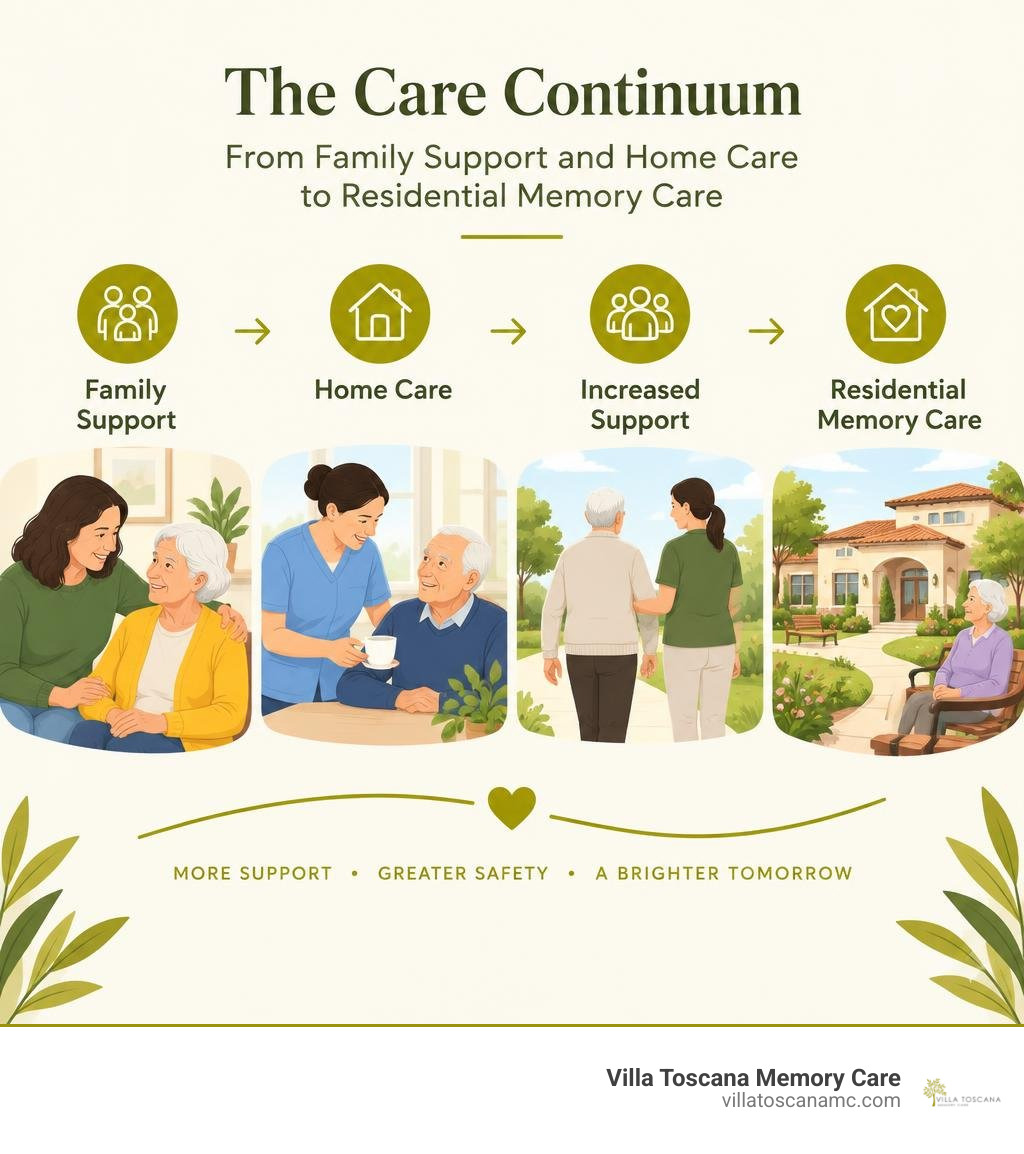
A well-chosen residential memory care community can expand the care team, giving your loved one consistent support while allowing you to spend more time being a son or daughter, not only a full-time caregiver.
Related content about memory care placement:
Recognizing the Clinical Signs for Memory Care Placement

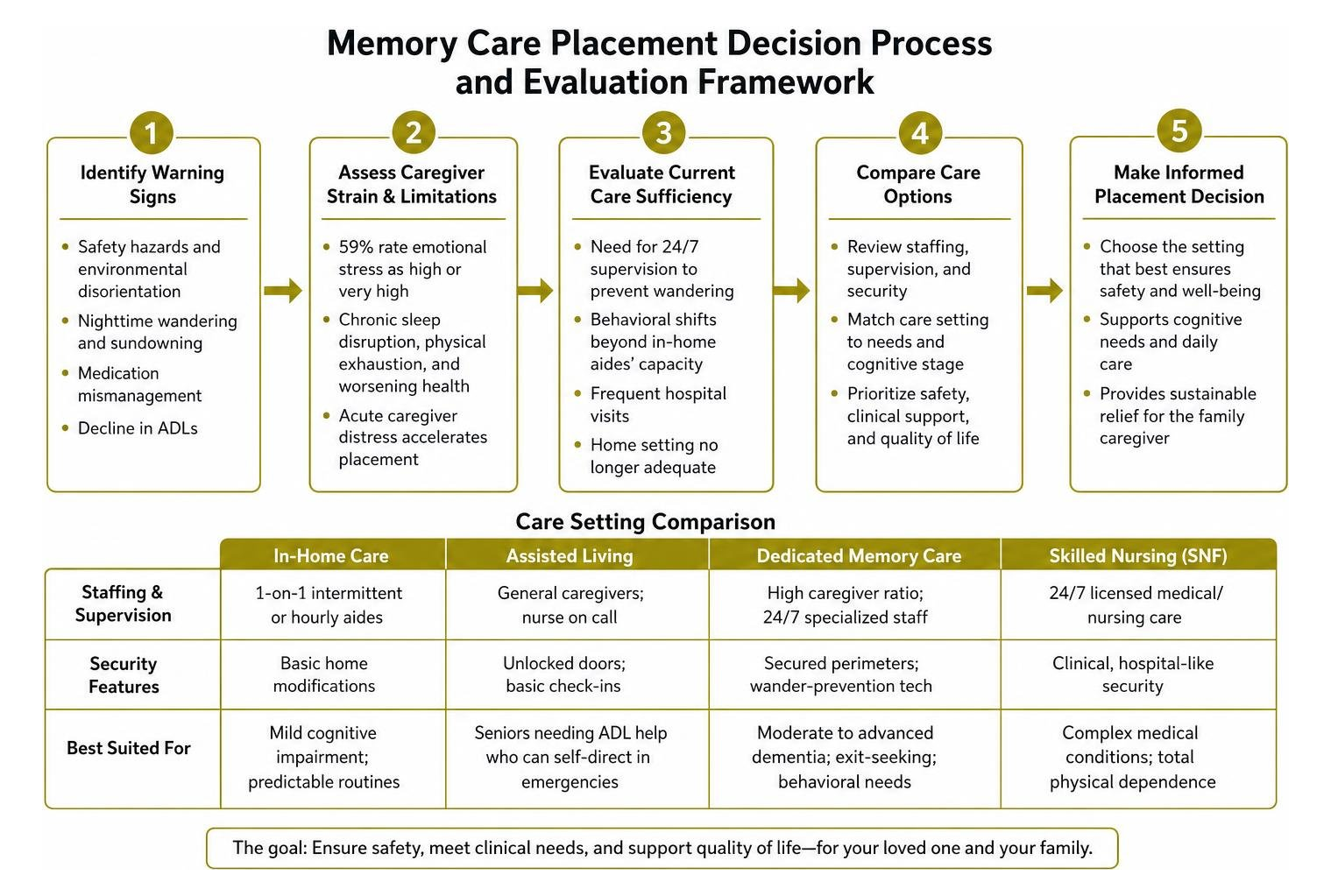
Dementia is a progressive condition. While early stages can often be managed with family support or intermittent home aides, there comes a point where cognitive impairment fundamentally changes a person’s safety profile. Identifying this inflection point is essential. It is not about waiting for a catastrophic emergency; it is about observing daily patterns and recognizing when residential dementia care is necessary.
Clinical markers that indicate it is time to evaluate specialized residential care include:
- Safety Hazards and Environmental Disorientation: Leaving stove burners unlit with gas flowing, forgetting how to navigate home stairs, or becoming lost in familiar surroundings.
- Nighttime Wandering and Sundowning: Severe agitation, confusion, or exit-seeking behaviors that escalate in the late afternoon and continue through the night, disrupting essential sleep cycles.
- Medication Mismanagement: Forgetting doses, taking double doses, or refusing vital prescriptions for chronic conditions like hypertension or diabetes.
- Decline in Activities of Daily Living (ADLs): Persistent challenges with bathing, dressing, toileting hygiene, and maintaining adequate hydration and nutrition.
Assessing Caregiver Burnout and In-Home Limitations
Nationwide, more than 63 million Americans provide unpaid care for aging loved ones, representing a massive 45% increase over the past decade. While caregiving is born out of love, the physical and emotional toll is immense. In fact, 59% of dementia caregivers rate their emotional stress as high or very high, and research shows that acute caregiver distress directly accelerates residential placement.
When you experience chronic sleep disruption, physical exhaustion, and worsening personal health, your capacity to provide safe oversight diminishes. Relying solely on intermittent help or running on empty is unsustainable. Acknowledging these limitations is a responsible step toward safeguarding both your parent’s well-being and your own.
Recognizing When Current Care Is No Longer Sufficient
Many families attempt to piece together rotating family schedules, private duty aides, and adult day centers. While helpful initially, these fragmented arrangements often buckle as dementia progresses.
If a loved one requires 24/7 supervision to prevent wandering, exhibits sudden behavioral shifts that in-home aides are not equipped to de-escalate, or experiences frequent hospital visits, the home setting is no longer adequate. A dedicated clinical environment provides the continuous structure and oversight that a private household simply cannot sustain.
Navigating Residential Dementia Care: Finding the Right Setting
Navigating the senior living landscape requires understanding the distinct capabilities of each level of care. Up to 70% of assisted living residents experience some degree of cognitive impairment, and roughly 40% carry a formal diagnosis of Alzheimer’s disease or a related dementia. However, standard assisted living communities are not designed to handle advanced cognitive decline.
| Care Setting | Staffing & Supervision | Security Features | Best Suited For |
|---|---|---|---|
| In-Home Care | 1-on-1 intermittent or hourly aides | Basic home modifications | Mild cognitive impairment; predictable routines |
| Assisted Living | General caregivers; nurse on call | Unlocked doors; basic check-ins | Seniors needing ADL help who can self-direct in emergencies |
| Dedicated Memory Care | High caregiver ratio; 24/7 specialized staff | Secured perimeters; wander-prevention tech | Moderate to advanced dementia; exit-seeking; behavioral needs |
| Skilled Nursing (SNF) | 24/7 licensed medical/nursing care | Clinical, hospital-like security | Complex medical conditions; total physical dependence |
What Makes Dedicated Memory Care Clinically Different
Dedicated memory care differs from traditional assisted living in physical design, philosophical approach, and staff expertise. Rather than requiring the resident to adapt to their environment, the environment is intentionally engineered to support cognitive deficits.
Key clinical and structural differentiators include:
- Wander-Prevention Architecture: Circular hallways and secure interior courtyards allow residents to walk freely without encountering confusing dead ends or unsafe exits.
- Visual Landmarks and Cues: Color-coded wings, distinctive architectural features, and memory boxes outside suites assist with navigation and reduce spatial anxiety.
- Person-Centered Attunement: Care shifts from promoting independent autonomy to compassionate attunement—reading subtle non-verbal cues, offering simplified choices, and anticipating needs.
- Evidence-Based Non-Pharmacological Therapies: Daily schedules incorporate structured music therapy, sensory stimulation, and reminiscence activities that reduce distress naturally, aligning with established evidence-based criteria for memory care communities.
Staffing Ratios and Specialist Dementia Training
The heart of quality memory care lies in its caregiving team. In a specialized community, staffing ratios are significantly higher than in general assisted living—frequently maintaining ratios around 1 caregiver for every 5 to 6 residents during daytime hours.
Beyond numbers, specialized dementia training is non-negotiable. Caregivers must understand how to manage altered communication, interpret behavioral expressions of distress as unmet physical needs, and practice validation techniques. Families can learn more about staffing expectations by evaluating memory care staffing ratios and mandates. Furthermore, consistent caregiver assignments ensure that staff members develop an intuitive understanding of each resident’s unique personality, preferences, and baseline health.
Evaluating Communities: How to Tour and Screen Facilities

Selecting the right community involves thorough research and direct observation. Start by consulting local resources such as your regional Area Agency on Aging, local Alzheimer’s Association chapters, and geriatric care managers.
When preparing for this transition, families should approach facility tours with a structured checklist. Gathering objective data helps you look past aesthetic finishes and evaluate the actual quality of care provided, ensuring thorough preparation as outlined in guides for preparing for long-term residential transitions.
Essential Questions to Ask on Facility Tours
During your visits, observe how staff interact with residents. Are conversations warm and engaging, or purely transactional? Are residents active, or are they left sitting in front of a television?
Key questions to ask leadership include:
- What is your caregiver-to-resident ratio across all shifts, including nights?
- What specific dementia care training and certifications does your direct-care staff receive annually?
- What is your annual staff turnover rate, and how do you ensure inter-shift communication?
- Is there licensed nursing coverage on-site 24/7, and how often does your medical director review care plans?
- How do you handle dining for residents with dysphagia or changing dietary needs? (At Villa Toscana Memory Care, our culinary partnership with Giorgio’s Italian Grill delivers restaurant-quality, nutrient-dense meals tailored to individual dietary textures and preferences.)
- Can we drop in for an unannounced evening visit before signing an agreement?
Preparing Legal, Financial, and Medical Records for Memory Care Placement
A smooth transition requires having essential paperwork in order well before move-in day. Gather these critical documents early:
- Healthcare Power of Attorney (DPOA) & Advance Directives: Designating trusted agents for medical decisions.
- Durable Financial Power of Attorney: Allowing family to manage billing, banking, and real estate matters.
- POLST / DNR Orders: Clear, signed medical directives reflecting the individual’s end-of-life care wishes.
- Comprehensive Clinical Assessment: Recent physician notes, cognitive testing scores, medical history, tuberculosis screening, and current medication administration records (MAR).
Understanding Costs, Pricing Structures, and Funding Sources
The financial commitment for residential memory care is substantial. Nationally, the median cost for memory care averages approximately $8,399 per month, reflecting the intensive staffing and specialized programming required. By comparison, assisted living averages $74,400 annually, while total national expenditures for dementia care will reach an estimated $409 billion in 2026.
Monthly billing typically consists of a base rate (covering rent, meals, utilities, and general activities) combined with tiered care fees based on the resident’s specific ADL needs. For a detailed review of regional cost variations, review our comprehensive memory care cost breakdowns.
Medicare, Medicaid, and State Benefit Programs
Understanding the boundaries of public health coverage is vital:
- Medicare: Does not pay for long-term custodial care or room and board in assisted living or memory care. It covers only medical services, physician visits, skilled therapies, and hospice care.
- Medicaid: May cover memory care costs through Home and Community-Based Services (HCBS) waivers or in licensed skilled nursing settings once personal assets are spent down to state-mandated limits.
- PACE (Program of All-Inclusive Care for the Elderly): In select regions, PACE coordinates medical and social services for eligible older adults, helping offset specific care expenses.
Private Insurance, VA Benefits, and Alternative Funding
Families often utilize a combination of private resources to fund residential care:
- Long-Term Care Insurance: Policies typically cover memory care facilities once the individual requires assistance with two or more ADLs or requires supervision due to cognitive impairment.
- VA Aid and Attendance: Eligible wartime veterans and surviving spouses can receive monthly, tax-free pension enhancements to offset the cost of assisted living and memory care.
- Life Insurance Settlements & Bridge Loans: Options such as converting a life insurance policy into a pre-funded care account or securing short-term bridge financing while selling family real estate.
Managing Moving Day Logistics and Post-Placement Guilt
Moving day is an emotional milestone that requires thoughtful logistical planning. To minimize confusion and sensory overload, consider these practical strategies, supported by expert practical tips for moving a parent with cognitive decline:
- Time the Move for Morning: Relocate early in the day when cognitive energy is highest, avoiding late-afternoon sundowning hours.
- Stage the Apartment in Advance: Arrange furniture, hang familiar family photos, and place their favorite bedspread before your parent arrives, creating an immediate sense of home.
- Keep the Arrival Calm: Avoid bringing large groups on move-in day. One or two calm, familiar family members provide reassuring presence without overwhelming the senses.
- Utilize Professional Respite: If you need time to prepare the transition, consider short-term respite care to give your loved one a gentle introduction to community life.
Coping with Caregiver Guilt and Emotional Stress After Memory Care Placement
It is entirely normal to feel a wave of guilt, grief, and sadness after placing a parent in memory care. Many caregivers experience anticipatory grief—mourning the gradual loss of their parent’s cognitive abilities while they are still alive—and disenfranchised grief, which society often overlooks.
Remind yourself of the guilt architecture: cultural expectations often tell us we should manage everything alone. In reality, choosing memory care is not abandoning your loved one; it is ensuring they receive professional, 24-hour safety. Reframe the move as expanding the care team. Joining local support groups and speaking with a counselor can help you process these complex emotions and establish healthy emotional boundaries.
Long-Term Advocacy and Establishing Care Partnerships
Your role does not end when your parent moves into a community—it evolves. You transition from an exhausted, task-focused caregiver into an empowered advocate and loving family member.
Build strong relationships with direct care aides, nurse managers, and life enrichment directors. Attend every scheduled care plan conference, share details about your parent’s life history and passions, and explore specialized life enrichment and sensory programs to keep your loved one socially connected and engaged.
Frequently Asked Questions About Dementia Care Placement
When should a person with dementia stop living alone?
A person with dementia should transition to a supervised living setting when safety risks at home become unmanageable. Clear signs include wandering away from home, forgetting to take vital prescription medications, neglecting basic hygiene and nutrition, leaving cooking appliances unattended, or experiencing severe disorientation during nighttime hours. If their safety cannot be guaranteed around the clock, independent living is no longer safe.
Does Medicare pay for room and board in memory care?
No, Medicare does not pay for room and board in memory care or assisted living communities. Medicare is designed to cover acute medical care, doctor visits, hospital stays, short-term skilled rehabilitation, and hospice care. Families must fund residential memory care through private savings, long-term care insurance, VA benefits, or Medicaid programs where available.
How often should families visit during the first few weeks after placement?
During the initial two to three weeks, establish a consistent, predictable visiting routine that supports adjustment. Brief, positive visits during daytime activity hours or shared meals work best. Coordinate closely with the community staff; in some cases, allowing a short adjustment window of a few days helps the resident bond with caregivers and adapt to community routines.
Conclusion
Making the decision to transition a parent or spouse into memory care is one of the most loving, selfless choices a family can make. It places their physical safety, emotional dignity, and specialized health needs at the forefront, while allowing you to reclaim your essential role as a supportive family member.
At Villa Toscana Memory Care, we provide luxury-style, family-owned memory care designed to offer peace of mind. With 24-hour trained staff, award-winning architectural design, engaging life enrichment programs, and exceptional dining in Mountain View, CA, we ensure your loved one receives the highest standard of compassionate support.
Begin your journey with confidence. Connect with our dedicated team today by exploring premier memory care community living to schedule a personalized tour and discover how we can support your family.