
Why the Staffing Ratio for Memory Care Matters
A staffing ratio for memory care shows how many residents each direct-care caregiver is responsible for during a shift. Lower resident-to-staff numbers usually allow for faster help, closer supervision, and more personal care. But the best choice is not simply the facility with the lowest advertised ratio.
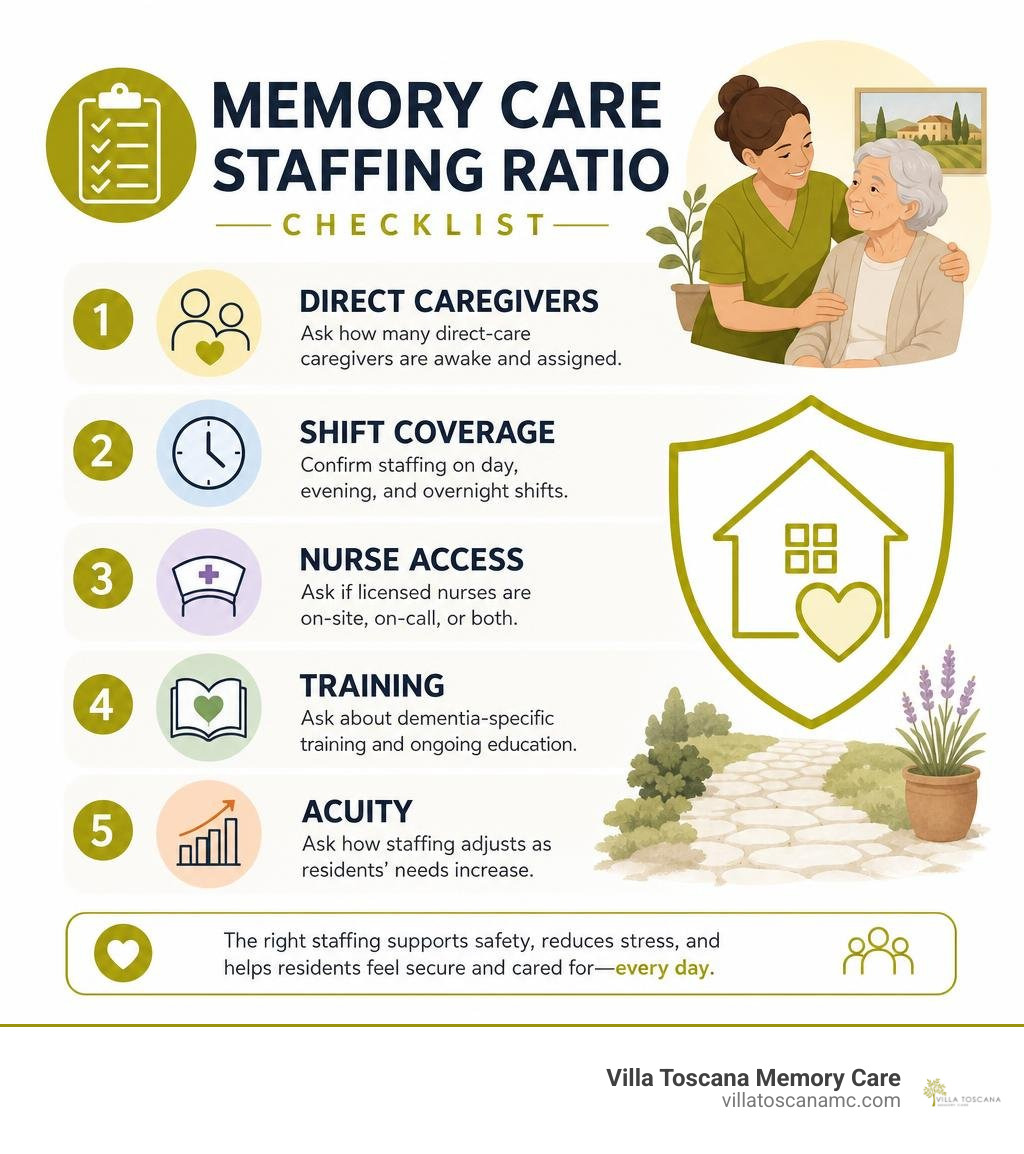
When evaluating a community, ask for the actual direct-care staffing on each shift:
- How many caregivers are awake and assigned to memory care during the day, evening, and overnight?
- Are licensed nurses on-site, on-call, or both?
- Does staffing increase when residents need more help with mobility, bathing, wandering, or dementia-related behaviors?
- How often do the same caregivers work with your parent?
State rules set a legal floor, not necessarily the level of staffing your parent needs. For example, Virginia requires at least two awake direct-care staff in most special care units with up to 20 residents during non-night hours, with more staff added as census rises. Night requirements also change by resident count.
Ratios matter because memory care residents may need help without warning – after a fall, during nighttime wandering, or when confusion and agitation increase. Training, experience, staff turnover, and response time are just as important as the headcount.
Understanding the Staffing Ratio for Memory Care vs. Standard Assisted Living
Navigating the senior living landscape can feel like learning an entirely new language. When families tour a traditional assisted living community, they often hear about staff ratios around 1:12 to 1:15 during the day. In standard assisted living, residents generally retain a degree of autonomy. They might need a helping hand with buttons in the morning or a polite reminder to head down to lunch, but they can ring a call bell and wait a few minutes without immediate safety risks.
Memory care is an entirely different environment. Progressive cognitive conditions—such as Alzheimer’s disease, vascular dementia, and Lewy body dementia—affect executive functioning, motor planning, spatial awareness, and verbal communication. Residents in specialized memory care often require total hands-on assistance with activities of daily living (ADLs), including bathing, dressing, continence management, and eating. Beyond personal hygiene, staff must continuously monitor for exit-seeking behaviors, manage emotional distress, and de-escalate anxiety.
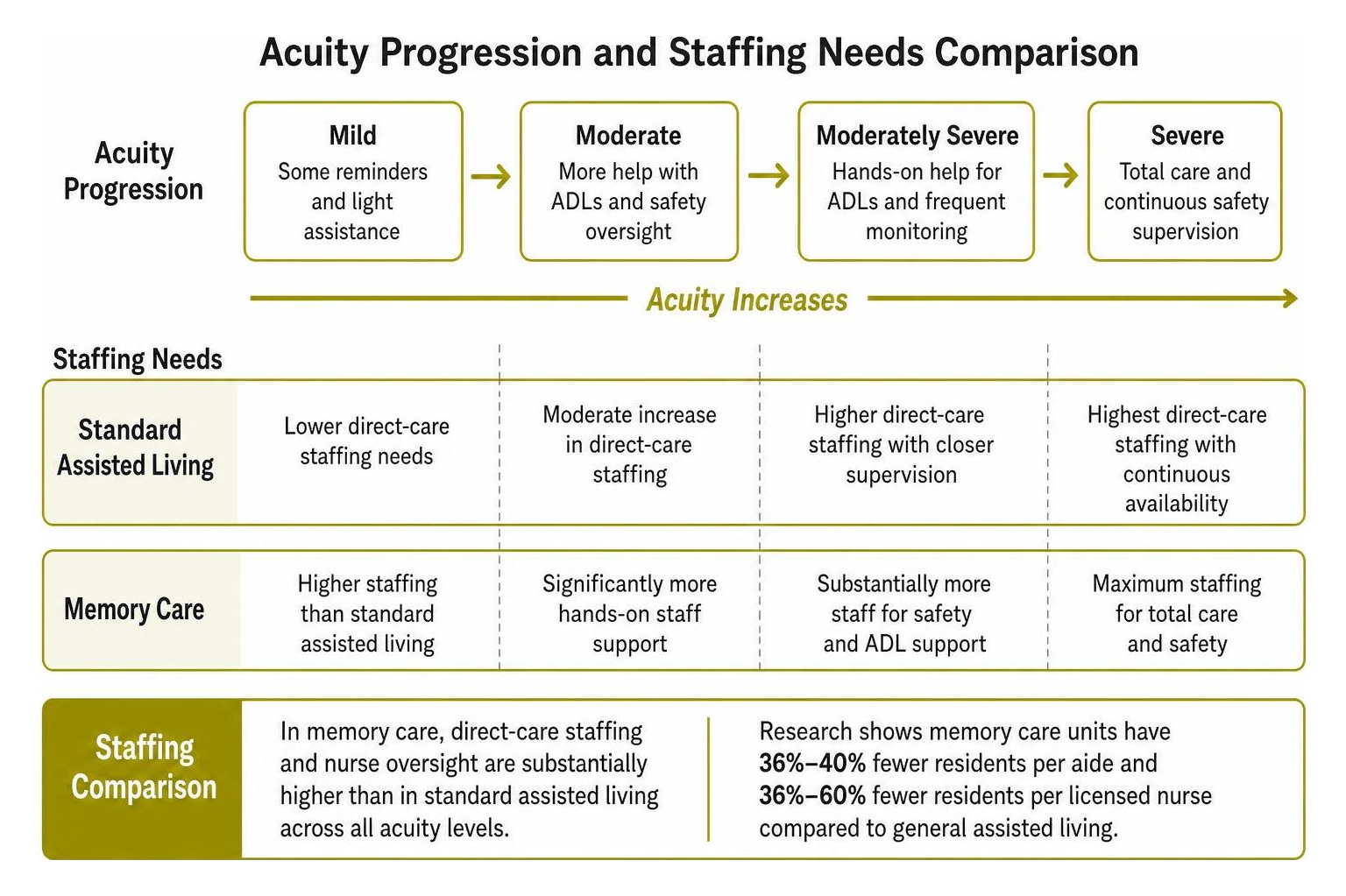
According to research on shift staffing patterns in memory care units, dedicated memory care units allocate significantly more direct-care hours per resident than generalized settings (Bowblis et al., 2024). For example, empirical studies show that aides in assisted living memory care units care for 36% to 40% fewer residents than their counterparts in the general assisted living facility. Similarly, licensed nurses in these specialized units oversee 36% to 60% fewer residents.
Meeting these intense needs requires structural safeguards that keep caregivers close at hand, allowing them to anticipate needs before they escalate into emergencies.
Day vs. Night Shift Variations in Specialized Care
Staffing numbers naturally shift over a 24-hour cycle, but memory care requires active vigilance around the clock.
- Day Shift (Morning & Afternoon): This is the peak window for physical care, structured engagement, therapy, and meals. A typical day ratio ranges from 1:5 to 1:8 in high-touch memory care environments.
- Evening Shift: As daylight fades, many individuals experience “sundowning”—a pattern of heightened confusion, anxiety, restlessness, and wandering. Facilities must maintain strong caregiver numbers into the evening to guide calming routines and prevent agitation.
- Night Shift (Overnight): While standard assisted living communities might operate with ratios of 1:20 or higher while residents sleep, memory care residents do not always sleep on a typical schedule. Disrupted circadian rhythms can lead to nocturnal wandering, sleep-wake reversals, and urgent bathroom trips in the dark.
An unassisted trip out of bed at 2:00 AM can easily lead to a fall. Consequently, memory care facilities require awake, active overnight staff to perform hourly checks and provide immediate support.
Hours Per Resident Day (HPRD) and Acuity-Based Models
While simple headcounts (like 1:6) give a snapshot, healthcare professionals frequently measure staffing depth using Hours Per Resident Day (HPRD). HPRD calculates the total direct-care nursing and aide hours divided by the total number of residents in a 24-hour cycle.
| Care Setting / Unit | Typical Direct-Care HPRD | Average Day Aide Ratio | Overnight Licensed Nurse Presence |
|---|---|---|---|
| Standard Assisted Living | 2.0 – 3.0 HPRD | 1:12 – 1:15 | Often on-call or shared |
| Memory Care (Assisted Living) | 3.8 – 5.5 HPRD | 1:5 – 1:8 | Dedicated awake staff; on-site/on-call nurse |
| Skilled Nursing Facility (General) | 3.5 – 4.2 HPRD | 1:8 – 1:10 | 24/7 on-site licensed nurse |
| Skilled Nursing (Memory Care Unit) | 4.5 – 6.0+ HPRD | 1:6 – 1:8 | 24/7 on-site licensed nurse |
Under an acuity-based staffing model, staffing is not fixed to a static headcount. Instead, leadership dynamically adjusts the caregiver schedule depending on the aggregate physical and cognitive dependency of the current residents. When several residents require two-person transfers or intensive behavioral support, overall staffing is increased to protect safety.
Whether your family is exploring full-time residency or seeking ways of ensuring safe care for your loved one, understanding this link between acuity and staff hours is essential.
State-by-State Regulatory Standards and Federal Mandates
Unlike skilled nursing homes, which must adhere to overarching federal regulations tied to Medicare and Medicaid certification, assisted living and memory care units are governed primarily at the state level. This creates a patchwork of regulations across the United States.
A comprehensive study on state memory care regulations and adverse events revealed stark contrasts in how states approach memory care staffing (Manhester et al., 2025). Some states establish strict numeric ratios, whereas others use vague terminology requiring “sufficient staff to meet resident needs.”
- Wisconsin: Mandates at least 3 hours of individual nursing care per week for memory care residents, yielding an average of 6.1 direct-care HPRD—the highest among several evaluated states (Manhester et al., 2025).
- California: Enforces day ratios around 1:10 direct-care staff in specialized units, though facility-level direct-care hours average 3.9 HPRD (Manhester et al., 2025), trailing the national memory care average of 4.9 HPRD.
- Ohio: Under Ohio Administrative Code (Rule 173-39-02.16), memory care providers must maintain a direct-care staff ratio that is at least 20% higher than their basic assisted living service ratio. If no basic service benchmark exists, the statutory floor is at least 1 direct-care staff member per 10 residents.
On the federal front, the CMS minimum staffing standards established baseline nursing benchmarks for federally certified nursing facilities (requiring 3.48 total HPRD, with 0.55 RN and 2.45 nurse aide hours). While this rule directly governs nursing homes rather than private assisted living memory care communities, it has prompted nationwide state-level legislative discussions regarding standardized staffing floors for dementia care.
Virginia and Georgia Specific Special Care Unit Regulations
Examining specific state mandates highlights how jurisdictions approach specialized memory care units:
Virginia (22VAC40-73-1130)
Virginia establishes precise, tiered staffing thresholds for Special Care Units (SCUs):
- Non-Night Hours: An SCU with 20 or fewer residents must maintain at least two direct-care staff members awake and on duty. An additional staff member is required for every additional 10 residents (or portion thereof).
- Night Hours: An SCU with 22 or fewer residents must have at least two awake direct-care staff members on duty. For 23 to 32 residents, three awake staff are required; for 33 to 40 residents, four awake staff are required.
Georgia (Ga. Comp. R. & Regs. R. 111-8-62-.19)
The Georgia certified memory care center requirements enforce a blend of strict ratios and scaled nurse presence:
- Direct Care: At least one dementia-trained direct-care caregiver per 12 residents during waking hours, and 1 per 15 residents during non-waking hours.
- Licensed Nursing Oversight: Communities must provide on-site nursing hours scaled to census:
- 1–12 residents: Minimum 8 nurse hours per week
- 13–30 residents: Minimum 16 nurse hours per week
- 31–40 residents: Minimum 24 nurse hours per week
- Over 40 residents: Minimum 40 nurse hours per week
Evaluating the Optimal Staffing Ratio for Memory Care by Shift

State rules represent minimum legal thresholds, not necessarily best practices. In an optimal setting, daytime caregiver ratios should ideally hover between 1:5 and 1:7. This allows caregivers to spend unhurried time engaging residents, rather than merely rushing through a checklist of physical tasks.
In Ohio, researchers discovered that in general assisted living facilities, the average aide-to-resident ratio during the day was 14.1-to-1 (Bowblis et al., 2024). In contrast, memory care units maintained an 8.0-to-1 ratio (Bowblis et al., 2024).
When evaluating options, families should compare how a community’s specialized wing staffing compares to its baseline services.
Quality of Care Beyond the Numbers: Training, Turnover, and Safety Risks
Headcount alone does not determine the quality of care. A community might technically meet a 1:6 ratio, but if three of those caregivers started yesterday and received no specialized dementia training, the living environment can quickly become chaotic.
Caring for someone with cognitive impairment requires patience, emotional intuition, and specialized skills. Compassionate communication helps ease distress and connects with dementia care support to relieve caregiver burden across families and professional teams alike.
Why Caregiver Turnover and Dementia Training Matter More Than Raw Ratios
The national average annual turnover rate for direct-care workers in assisted living and memory care exceeds 45%. In some under-resourced facilities, it climbs above 70%. High turnover is particularly disruptive for memory care residents.
Individuals with memory loss rely heavily on familiar faces, consistent vocal tones, and predictable routines. When a new caregiver enters their room every shift, residents can experience heightened anxiety, confusion, and resistance to care.
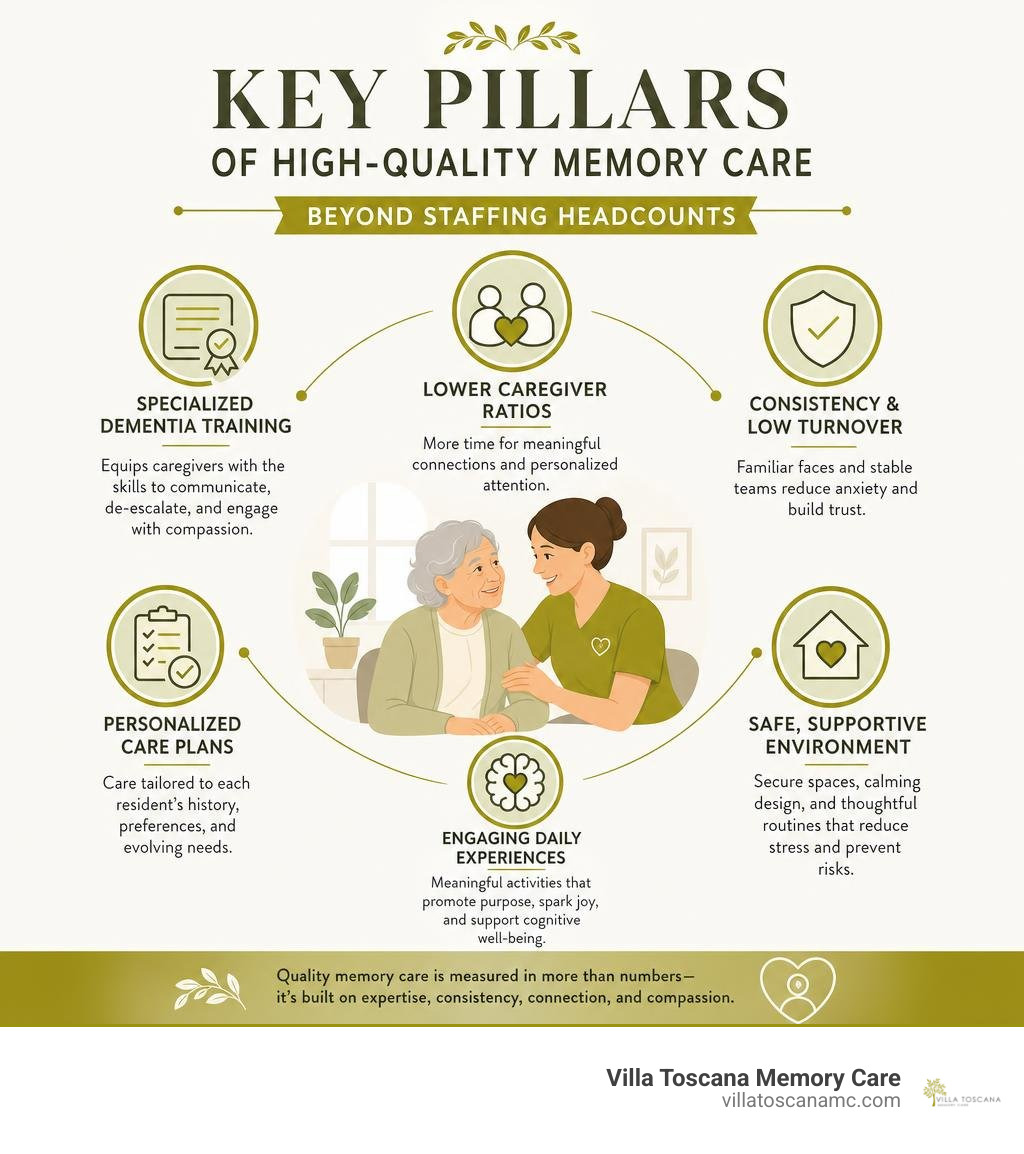
Furthermore, direct-care teams need training that goes well beyond standard first aid. Specialized dementia training should encompass:
- Behavioral De-escalation: Recognizing that agitation or aggression often stems from unmet physical needs (pain, hunger, temperature) or environmental overstimulation.
- Validation Techniques: Stepping into the resident’s reality rather than arguing with or correcting them.
- Sensory and Cognitive Engagement: Designing and facilitating stimulating activities for seniors with memory loss that promote purpose and joy.
A facility with a stable 1:8 ratio and tenured, dementia-certified caregivers frequently delivers far safer, more personalized care than a 1:5 facility reliant on temporary agency personnel.
The Consequences of Inadequate Overnight Staffing
Night shifts are vulnerable windows in memory care. A study across Ohio assisted living facilities revealed that 23% of communities reported zero licensed nurses on duty during overnight shifts, with overnight licensed nurse ratios averaging 42.5-to-1 (Bowblis et al., 2024).
When overnight staffing is thin, several risks escalate:
- Increased Fall Rates: A resident waking up disoriented may attempt to walk to the bathroom unassisted. Without awake staff conducting prompt rounds, fall risks surge.
- Delayed Incontinence Care: Prolonged exposure to soiled garments leads to skin breakdown, pressure injuries, and painful urinary tract infections (UTIs)—which in turn trigger acute delirium.
- Unmonitored Wandering and Elopement: Residents experiencing sleep disturbances may attempt to exit the building or enter other residents’ rooms.
- Elevated Hospitalizations: Minor medical issues that could be managed early by an alert nurse or caregiver are left unchecked until they require emergency room intervention.
How Families Can Verify Actual Staffing Levels During Community Tours

Marketing brochures often present an idealized vision of community life. To understand what daily life will look like for your loved one, you must look closely at day-to-day operations.
Whether touring communities for permanent placement or evaluating everything families need to know about short-term respite care, transparency is paramount.
Questions to Ask to Verify the True Staffing Ratio for Memory Care
During your tour, ask detailed questions regarding staffing logistics:
- “How many direct-care aides are exclusively assigned to this memory care floor on the day, evening, and night shifts?”
- “Do administrative staff, activity directors, or dining servers count toward your direct-care caregiver ratio?”
- “What is your licensed nurse coverage? Is a nurse on-site 24/7, or are they on-call after 5:00 PM?”
- “What is your annual staff turnover rate among direct-care aides?”
- “How do you handle call-outs? Do you use outside agency staff who may be unfamiliar with our parent’s care plan?”
- “Are all direct-care staff certified in CPR, first aid, and specialized dementia management?”
- “What is your average response time when a resident pendant or sensor alert is triggered?”
Red Flags and Advertised vs. Actual Direct-Care Staffing
Be watchful for subtle discrepancies between what is advertised and what is practiced:
- Ratio Inflation: Some marketing teams divide the total resident population by all building employees—including marketing managers, culinary staff, and housekeepers—and claim an “impressive” 1:3 ratio. Insist on knowing the dedicated aide-to-resident ratio for direct bedside care.
- Unsupervised Common Areas: If you walk through a memory care wing mid-morning and observe multiple residents sitting unattended in common spaces with no staff in sight, caregivers may be overwhelmed with room care.
- High Caregiver Stress and Fatigue: Take note of staff demeanor. Are caregivers smiling, speaking gently, and interacting warmly, or do they appear hurried and visibly stressed?
- Slow Call Response: If call lights or door alarms chime continuously during your visit without prompt staff intervention, staffing depth may be inadequate.
Frequently Asked Questions About Memory Care Staffing
Is there a federal minimum staffing ratio for memory care?
No. There is no single federal statute setting direct staff-to-resident ratios for assisted living memory care communities. Regulations are defined individually by each state’s licensing department. Federal standards, such as CMS regulations, apply specifically to Medicare- and Medicaid-certified skilled nursing facilities.
What is considered a good staff-to-resident ratio in memory care?
A high-quality standard for daytime memory care is generally 1:5 to 1:8 direct caregivers to residents, depending on the average care needs in the community. Nighttime ratios should ideally not exceed 1:10 to 1:12, with all staff awake, active, and routinely monitoring rooms.
Do memory care units have nurses on-site 24/7?
This varies significantly based on state regulations and the community’s licensing tier. Some states only require a licensed nurse (RN or LPN) to be on-site during daytime business hours and on-call overnight. Other communities provide 24/7 on-site licensed nursing care. Always ask for written clarification on when a nurse is physically present in the building versus available by phone.
Choosing the Right Care Environment for Your Family
A memory care staffing ratio is more than just an abstract number on an administrative report. It directly shapes how quickly your parent receives assistance when getting out of bed, the patience they experience during meals, and whether their emotional world is supported with dignity.
When evaluating communities, look beyond the surface decor. Examine direct-care hours per resident day, observe staff engagement, ask tough questions about overnight coverage, and prioritize teams that invest heavily in specialized dementia education and caregiver retention.
At Villa Toscana Memory Care, we believe exceptional dementia care begins with an intentional, supportive environment. Located in Mountain View, CA, our boutique, family-owned community combines specialized memory care programming with a dedicated, well-trained caregiving team. With our distinctive culinary partnership with Giorgio’s Italian Grill, we ensure that every resident receives attentive, personalized support, dignified dining, and compassionate 24-hour care tailored to their unique life story.
References
Bowblis JR, Menne HL, Nelson M, Elliot A. “Staffing Patterns in Nursing Homes, Assisted Living Communities, and Memory Care Units: Variation Across Shifts..” Journal of the American Medical Directors Association, 2024. PMCID PMC12010473. Margaret Manhester, Jalayne J Arias, Victoria Helmly, Catherine E A Scipion, Alice Prendergast, Olusheun Olupitan. “A Snapshot of Memory Care: Regulation, Staffing, and Adverse Events in Memory Care Units within Assisted Living Facilities.” Alzheimer’s & Dementia, 2025. PMCID PMC12726433.