
What Short-Term Respite Care Really Costs
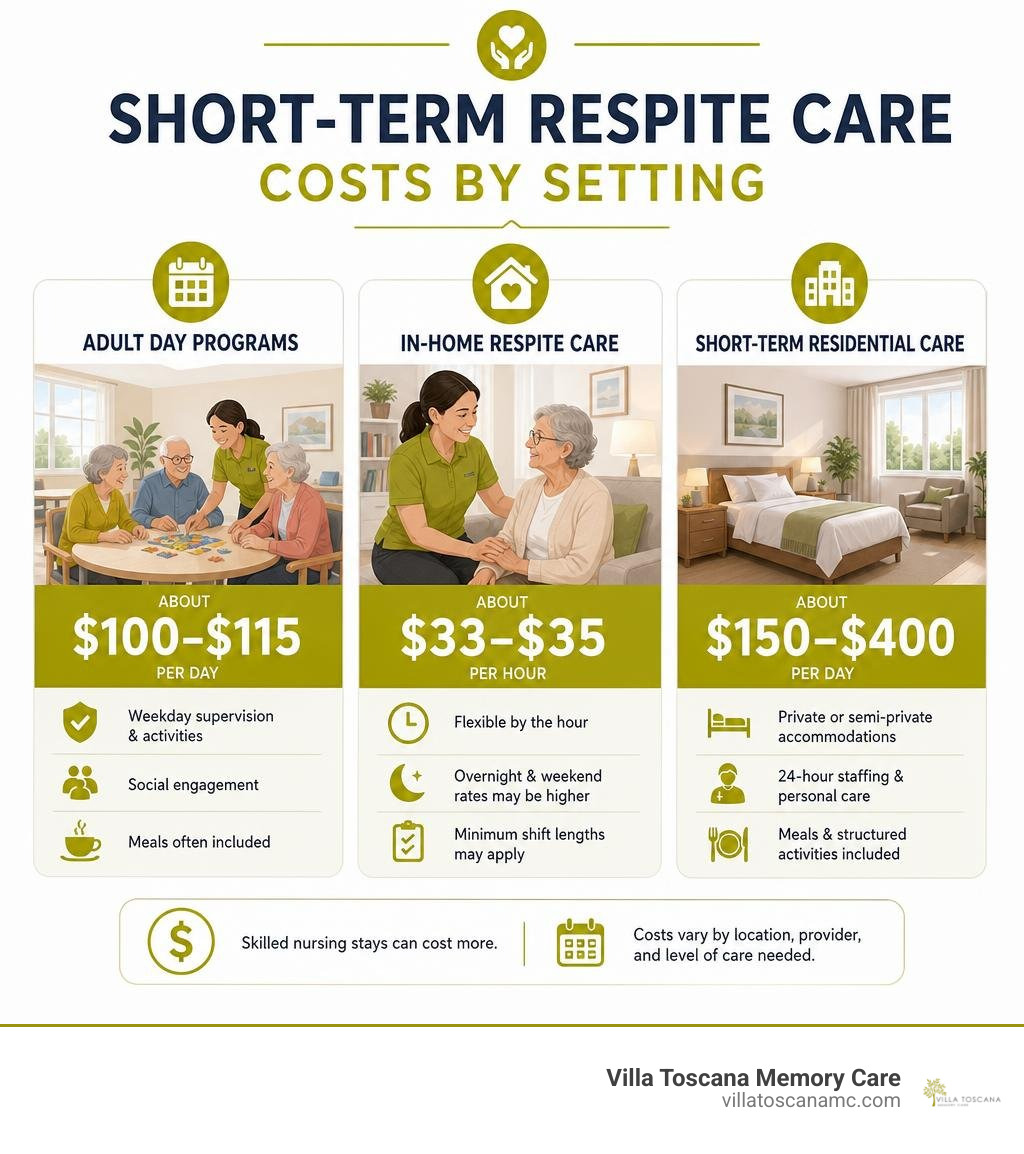
The cost of short term respite care depends mostly on where care happens and how much support a parent needs. National benchmarks put adult day care at about $100 to $115 per day, non-medical in-home care at roughly $33 to $35 per hour, and short-term residential care at about $150 to $400 per day. Skilled nursing stays can cost more.
For a quick comparison:
- Adult day programs: Often the lowest-cost option for safe weekday supervision and activities.
- In-home respite: Flexible for a few hours, but minimum shift lengths, overnight help, and weekend rates can raise the bill.
- Residential respite: Higher daily pricing, but it may include meals, 24-hour staffing, personal care, and structured activities.
For families caring for a parent with dementia, price matters, but so does the level of supervision. A lower hourly rate is not a true savings if it does not cover wandering risk, medication needs, mobility help, or behavioral changes. This guide breaks down the full cost picture, including add-on charges, payment options, and the point when frequent respite may cost more than a permanent memory care setting.
Average Cost of Short Term Respite Care Across Different Settings
When budgeting for temporary relief, the care setting dictates how providers structure their billing. In-home agencies bill on an hourly basis, adult day centers offer structured full-day or half-day rates, and residential communities charge comprehensive per-diem (daily) fees.
To help families understand current pricing, we have organized national benchmarks using 2026 respite care cost benchmarks across the major care settings.
| Care Setting | Average Hourly Rate | Average Daily / Shift Rate | Typical Monthly Equivalent | Billing Structure |
|---|---|---|---|---|
| In-Home Caregiver (Homemaker / Companion) | $30 – $35 / hr | $120 – $140 (4-hr minimum) | $5,280 – $6,160 (40 hrs/wk) | Hourly (3–4 hr shift minimums) |
| In-Home Health Aide (Personal Care) | $33 – $38 / hr | $195 (standard 8-hr daytime) | $6,878 (standard daytime hours) | Hourly |
| 24-Hour In-Home Care | $34 – $36 / hr | $817 / day | $24,510 / mo | 2–3 caregiver rotations / day |
| Adult Day Care / Health Center | $10 – $20 / hr | $100 – $115 / day | $2,058 – $2,299 / mo (weekdays) | Half-day or full-day flat rates |
| Assisted Living Respite Stay | N/A (Bundled) | $150 – $250 / day | $4,500 – $7,500 / mo | Per diem (lodging + meals included) |
| Specialized Memory Care Respite Stay | N/A (Bundled) | $200 – $400 / day | $6,000 – $12,000 / mo | Per diem (secure care + enrichment) |
| Skilled Nursing Facility (SNF) | N/A (Bundled) | $305 (Semi-Private) / $350 (Private) | $9,581 – $10,798 / mo | Per diem (clinical 24/7 care) |
Families exploring residential options often look at dedicated residential respite care services to balance safety, engagement, and around-the-clock peace of mind.
In-Home Caregiver and Homemaker Hourly Rates
In-home respite care allows a senior to remain in familiar surroundings while a professional caregiver steps in to take over daily duties.
- Homemaker and Companion Services: Primarily focus on non-medical support such as light housekeeping, meal preparation, and conversation. Nationally, these services average $30 to $35 per hour.
- Home Health Aides: Provide hands-on assistance with Activities of Daily Living (ADLs) like bathing, dressing, grooming, and incontinence care. Rates generally run $33 to $38 per hour.
- Shift Minimums: Most licensed home care agencies enforce a 3- to 4-hour minimum per visit. Even if you only need someone for 60 minutes to step out for groceries, you will typically pay the full 4-hour agency floor ($130 to $150).
- 24-Hour In-Home Care: Continuous home coverage requires rotating two or three shifts of caregivers to avoid overtime rules. This raises daily costs to approximately $817 per day, making around-the-clock home care significantly more expensive than facility-based care.
- Overnight Supervision: Agencies distinguish between “sleeping” and “active” overnight shifts. If the caregiver must remain awake to monitor wandering or assist with frequent bathroom visits, expect to pay standard or premium hourly rates throughout the night.
Adult Day Care and Health Center Daily Pricing
Adult day programs provide daytime supervision, structured socialization, meals, and basic health monitoring outside the home.
- Social Day Centers: Focus on group games, light exercise, meals, and companion supervision. These programs average $80 to $100 per day.
- Adult Day Health Care (ADHC): Incorporate on-site nursing, medication administration, physical therapy maintenance, and specialized dementia programming. National medians range from $100 to $115 per day (about $2,058 to $2,299 per month for full-time weekday participation).
- Transportation Add-Ons: Many adult day centers offer accessible van transit to and from home, which may be billed as an extra $10 to $30 round-trip fee if not covered by a local program waiver.
Adult day programs represent one of the most budget-friendly ways to maintain caregiver employment or personal errands during normal business hours.
Residential Assisted Living and Skilled Nursing Daily Stays
When a caregiver travels for work, takes a vacation, undergoes surgery, or experiences acute burnout, residential respite provides continuous temporary care in a dedicated facility.
- Assisted Living Respite: Typically ranges from $150 to $250 per day. This covers a furnished apartment, three daily meals, housekeeping, laundry, and scheduled social activities.
- Dedicated Memory Care Respite: Stays run $200 to $400 per day. These specialized settings feature secure environments to prevent wandering, higher staff-to-resident ratios, sensory enrichment, and staff trained specifically in dementia communication and behavioral de-escalation.
- Skilled Nursing Facility (SNF) Respite: Reserved for seniors who require continuous clinical oversight, wound management, or feeding tube support. Semi-private rooms average $305 per day ($9,581 monthly), while private rooms average $350 per day ($10,798 monthly).
Unlike hourly home care, residential per-diem pricing bundles lodging, utilities, dining, personal care, and 24-hour emergency response into a predictable rate.
Key Factors and Add-On Charges Influencing Respite Pricing

Respite care prices are not one-size-fits-all. Multiple variables influence the final invoice, and overlooking these factors can lead to unexpected out-of-pocket expenses. Caregivers can review our non-assisted-living respite guide for deeper breakdowns of community and home-based billing differences.
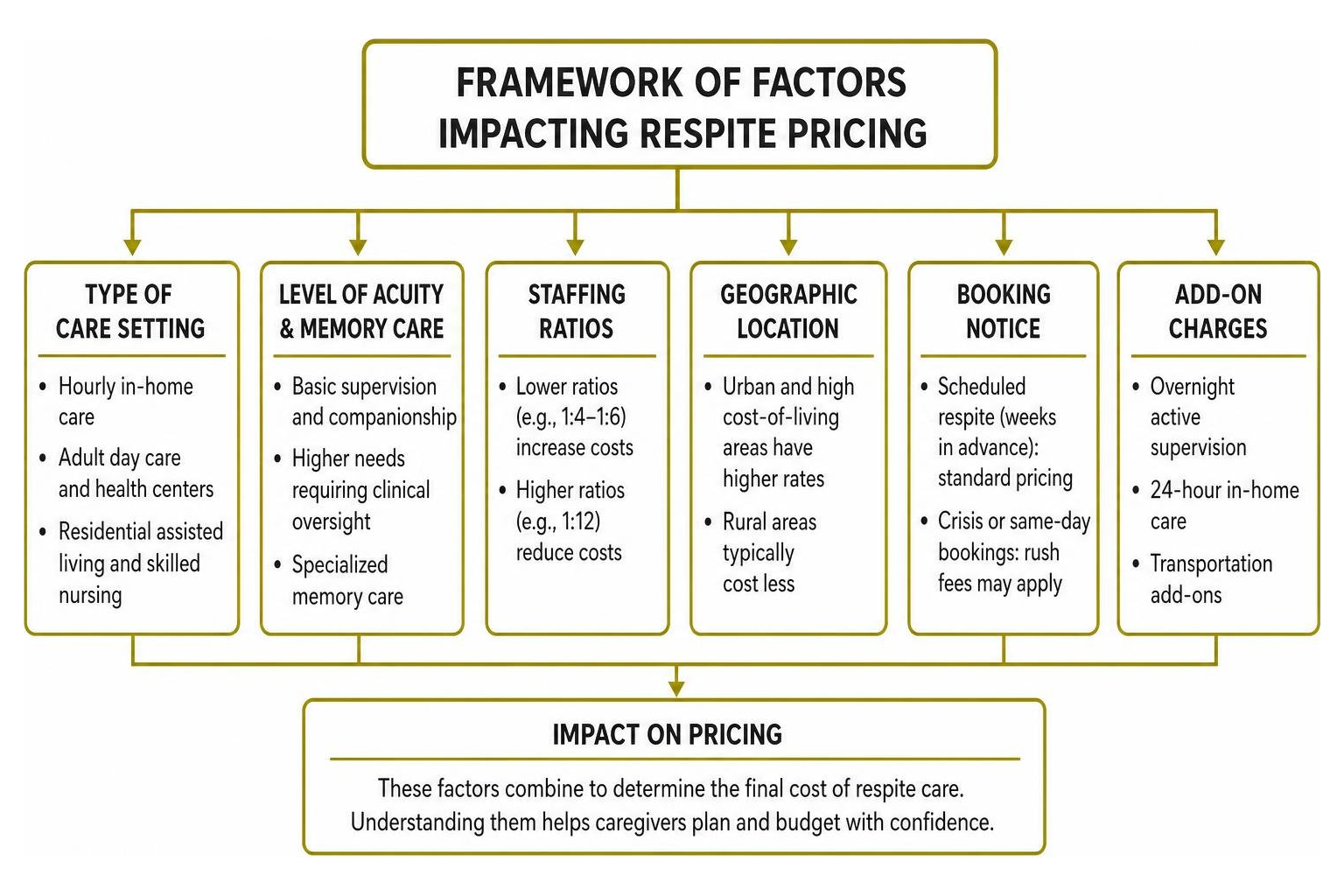
- Geographic Location and Regional Labor Rates: Senior care pricing reflects local living costs and labor market conditions. In metropolitan regions like Northern California or the Chicago North Shore, hourly agency rates often reach $40 to $50 per hour, and residential respite ranges from $250 to $450+ per day, compared to rural areas where daily rates may start near $150.
- Staffing Ratios: Communities and agencies maintaining lower ratios (e.g., 1 caregiver for every 4 to 6 residents in memory care) carry higher operational overhead than general assisted living settings with 1 to 12 ratios.
- Booking Notice (Scheduled vs. Crisis Respite): Planning several weeks ahead secures standard pricing. Emergency same-day bookings or crisis respite often incur rush onboarding fees ranging from $100 to $300.
Level of Acuity and Specialized Memory Care
The hands-on care a senior needs directly affects the price:
- Basic Companionship vs. High-Acuity Physical Support: A senior who is independent with mobility and personal hygiene incurs base-tier rates. If they require two-person transfers, mechanical lift assistance, total incontinence care, or specialized diabetic monitoring, agencies and facilities add acuity surcharges ($15 to $50+ per day).
- Dementia and Alzheimer’s Support: Cognitive decline requires specialized oversight. Memory care environments provide secured perimeters, structured routines, cueing, and behavioral support. These specialized services carry higher daily rates than standard assisted living because of the staff training and supervision required.
Hidden Fees That Increase the Total Cost of Short Term Respite Care
To prevent billing surprises, ask providers for an itemized breakdown covering these common add-on charges:
- Medication Management: Many communities and agencies charge separate tiers for administering prescriptions, ranging from $10 to $30 per day or $300 to $600 per month.
- Intake and Clinical Assessment Fees: Before admitting a resident for a short stay, communities require a nurse assessment to build a compliant care plan. This one-time fee typically runs $250 to $500.
- Weekend and Holiday Premiums: In-home agencies frequently bill an additional $3 to $8 per hour for weekend coverage and 1.5x regular rates on major national holidays.
- Minimum Stay Requirements: Residential assisted living and memory care facilities rarely admit respite guests for a single afternoon. Most require a minimum stay of 7, 14, or 30 days to offset cleaning, onboarding, and care-planning expenses.
- Cancellation Penalties: Understand the agency or community cancellation policy. Some providers retain initial deposits if reservations are canceled within 48 to 72 hours of the scheduled arrival date.
Comparing Temporary Respite Costs Against Permanent Senior Living

Many families rely on temporary respite as a long-term strategy to delay residential placement. However, using high volumes of short-term care can quietly become more expensive than transitioning to permanent senior living.
To evaluate accommodations, families often review purpose-built memory care floor plans alongside structured daily enrichment activities to see how full-time care compares to piecemeal home support.
Cumulative Expenses of High-Frequency Respite
Consider a family that schedules 40 hours of in-home care weekly at $35 per hour to cover working hours.
- 40 hours/week × $35/hour = $1,400 per week
- Monthly Care Invoice: $6,066 per month
In addition to the care invoice, the family continues paying for:
- Home mortgage or rent ($1,500 – $2,500)
- Groceries and meal preparation ($500 – $800)
- Utilities, electricity, and heating ($300 – $500)
- Home maintenance, cleaning, and yard care ($200 – $400)
- Total Monthly Outlay at Home: $8,566 – $10,266 per month
Alternatively, if a family uses two days of facility-based respite care every week ($225/day) plus two 4-hour in-home shifts ($140/shift), the combined respite bill alone totals roughly $2,920 monthly—providing only partial weekly relief while leaving the caregiver responsible for nights, mornings, and weekends.
Evaluating When the Cost of Short Term Respite Care Exceeds Long-Term Placement
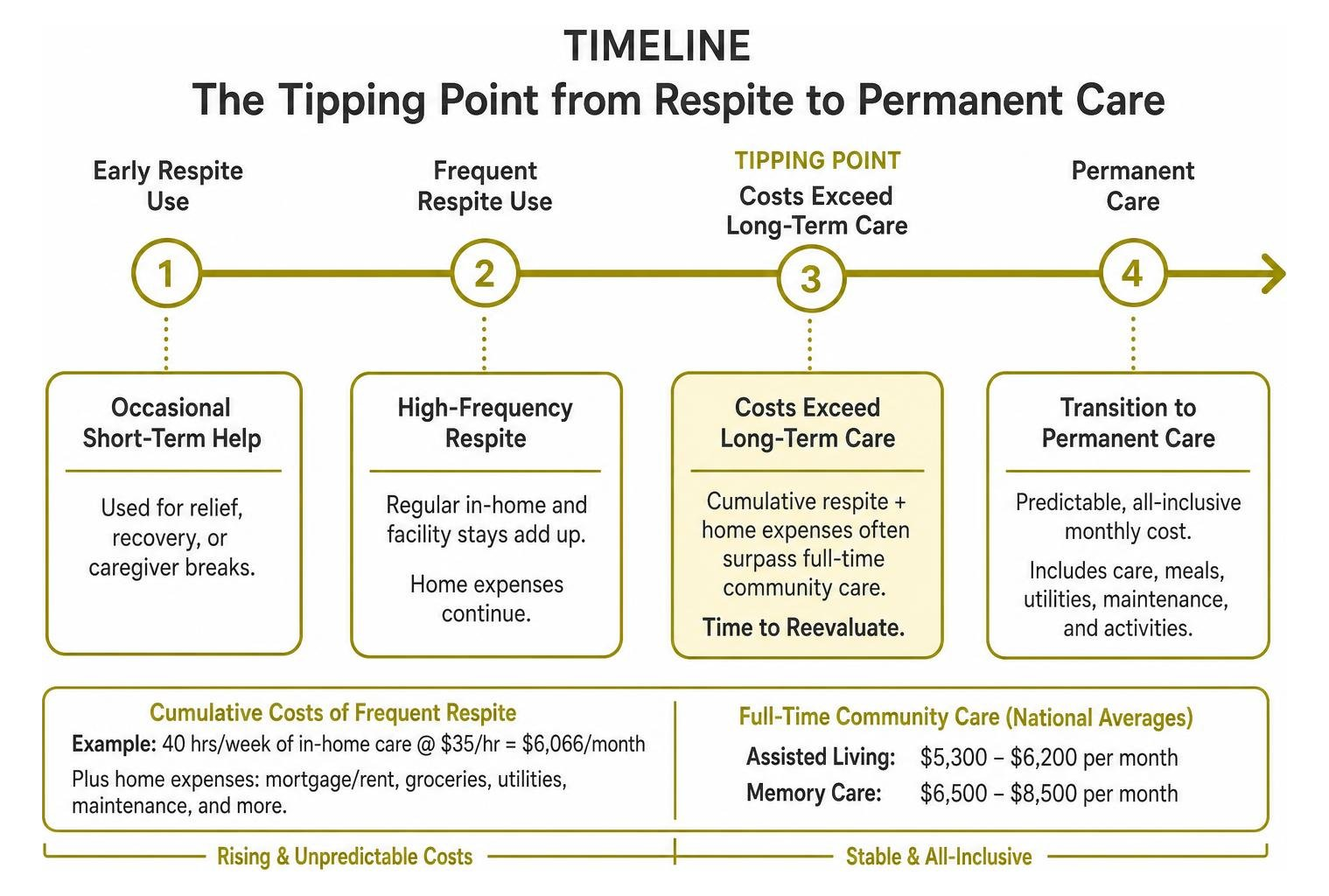
Full-time residential assisted living averages approximately $5,300 to $6,200 per month nationally, while comprehensive memory care typically ranges between $6,500 and $8,500 per month.
When you compare this all-inclusive monthly fee against the combined costs of frequent hourly care, groceries, home maintenance, and utilities, long-term placement often becomes the more financially sustainable choice.
Respite stays also provide an ideal trial period. Booking a 14-day or 30-day short-term stay lets the family evaluate how a loved one adapts to community routines, dining, and social interaction before making a permanent move.
Financial Assistance, Insurance Coverage, and Public Funding Resources
Because respite care is primarily considered custodial (non-medical) support, private pay remains the most common funding method. However, several public programs, insurance options, and tax credits can help offset costs.
For additional strategies, consult resources like respite care coverage and tax breaks and our guide on budget-conscious respite planning.
Medicare and Medicaid Coverage Limitations
- Medicare Part A Hospice Benefit: Original Medicare does not cover routine, standalone respite care. The only exception is under the Medicare Hospice Benefit: if a patient is certified terminally ill (life expectancy under six months) and receiving hospice at home, Medicare Part A covers up to 95% of inpatient respite care at an approved facility for up to 5 consecutive days at a time. The family pays a 5% coinsurance.
- Medicare Advantage (Part C): Certain Medicare Advantage plans offer supplemental benefits that cover a set number of adult day care hours or non-medical in-home care sessions per year. Check your annual Evidence of Coverage (EOC) document.
- The CMS GUIDE Model: Launched by Medicare in July 2024, the Guiding an Improved Dementia Experience (GUIDE) program provides participating healthcare practices with annual respite funding caps (up to $2,563 per year) for eligible dementia patients receiving care from an unpaid family member.
- Medicaid HCBS Waivers: Standard Medicaid does not automatically cover respite stays, but state-administered Home and Community-Based Services (HCBS) 1915(c) waivers or 1115 demonstration programs often fund adult day care, in-home personal aides, and limited short-term facility stays. That many state waiver programs have multi-month or multi-year waiting lists.
Veterans Benefits, Grants, and Tax Credits
- VA Aid and Attendance / Housebound Pension: Eligible wartime veterans and surviving spouses receiving the VA improved pension can put their monthly benefit toward short-term residential respite, adult day care, or home assistance.
- VA Respite Care Benefit: Enrolled veterans who meet clinical criteria can receive up to 30 days of respite care per calendar year at a contracted community nursing home, adult day health center, or via an approved home health agency.
- National Family Caregiver Support Program (NFCSP): Administered through local Area Agencies on Aging (AAA), this program provides small discretionary respite grants (often $500 to $1,500 annually) or service vouchers to eligible family caregivers.
- Lifespan Respite Care Programs (LRCP): State coalitions funded by federal grants offer competitive vouchers to help family caregivers purchase short-term respite relief.
- Tax Breaks and FSAs:
- IRS Medical Expense Deductions: Under IRS Publication 502, adult day health care and the clinical medical portion of facility-based respite may qualify as deductible medical expenses if overall out-of-pocket medical costs exceed 7.5% of your Adjusted Gross Income (AGI).
- Dependent Care Flexible Spending Accounts (DCFSA): Working caregivers claiming an elderly parent as a dependent can use pre-tax DCFSA funds (up to $5,000 annually) to pay for adult day care.
- Child and Dependent Care Tax Credit: Provides a non-refundable tax credit for qualifying care expenses paid to enable the primary caregiver to work or actively search for employment.
Frequently Asked Questions About Respite Care Costs
Does Medicare cover the cost of short-term respite care?
Original Medicare only covers short-term respite care when a patient is enrolled in Medicare-approved hospice care. In that scenario, Medicare Part A covers up to 5 consecutive days of inpatient respite care in an approved facility, with the patient responsible for a 5% copay. Original Medicare does not cover routine in-home respite, standard adult day care, or non-hospice assisted living respite stays.
What is the most budget-friendly short-term respite option?
Adult day programs generally offer the lowest daily cost, averaging $100 to $115 per day (or $10 to $20 per hour) including structured activities, meals, and social engagement. For in-home support on a tight budget, booking an aide for a 3- or 4-hour block focused only on high-demand tasks (such as morning bathing and dressing) is significantly more cost-effective than scheduling full-day or overnight shifts.
What questions should families ask to avoid hidden respite fees?
Before signing a respite agreement, ask providers the following:
- What is your minimum booking requirement (hours per shift or days per stay)?
- Is medication administration included in the base rate, or billed as a separate fee?
- What are your weekend, holiday, and overtime surcharges?
- For overnight care, does the rate cover active awake supervision or sleeping supervision?
- What is the pre-admission assessment fee, and is any portion of the deposit refundable if plans change?
Conclusion
Taking a planned break is not a luxury—it is essential to sustainable caregiving. When caregivers push past exhaustion, their own physical and emotional health suffers, which directly impacts the quality of care their loved one receives. Understanding the true costs and billing structures of short-term respite enables families to plan breaks proactively rather than scrambling during a crisis.
When a parent with memory loss requires consistent supervision, structured cognitive engagement, and specialized assistance, a purpose-built community provides a safe, welcoming environment. At Villa Toscana Memory Care, our family-owned, boutique community combines 24-hour specialized memory care with fine dining experiences through our on-site partnership with Giorgio’s Italian Grill. We invite you to request a tour of our Mountain View community to explore our respite and long-term care options.