
What Dementia Care Costs and How to Plan for It
Dementia care costs can range from part-time help at home to more than $10,000 a month for nursing home care. Start by estimating the level of help your parent needs now, then compare the full monthly cost of in-home care, memory care, and skilled nursing – including services not included in a base rate.
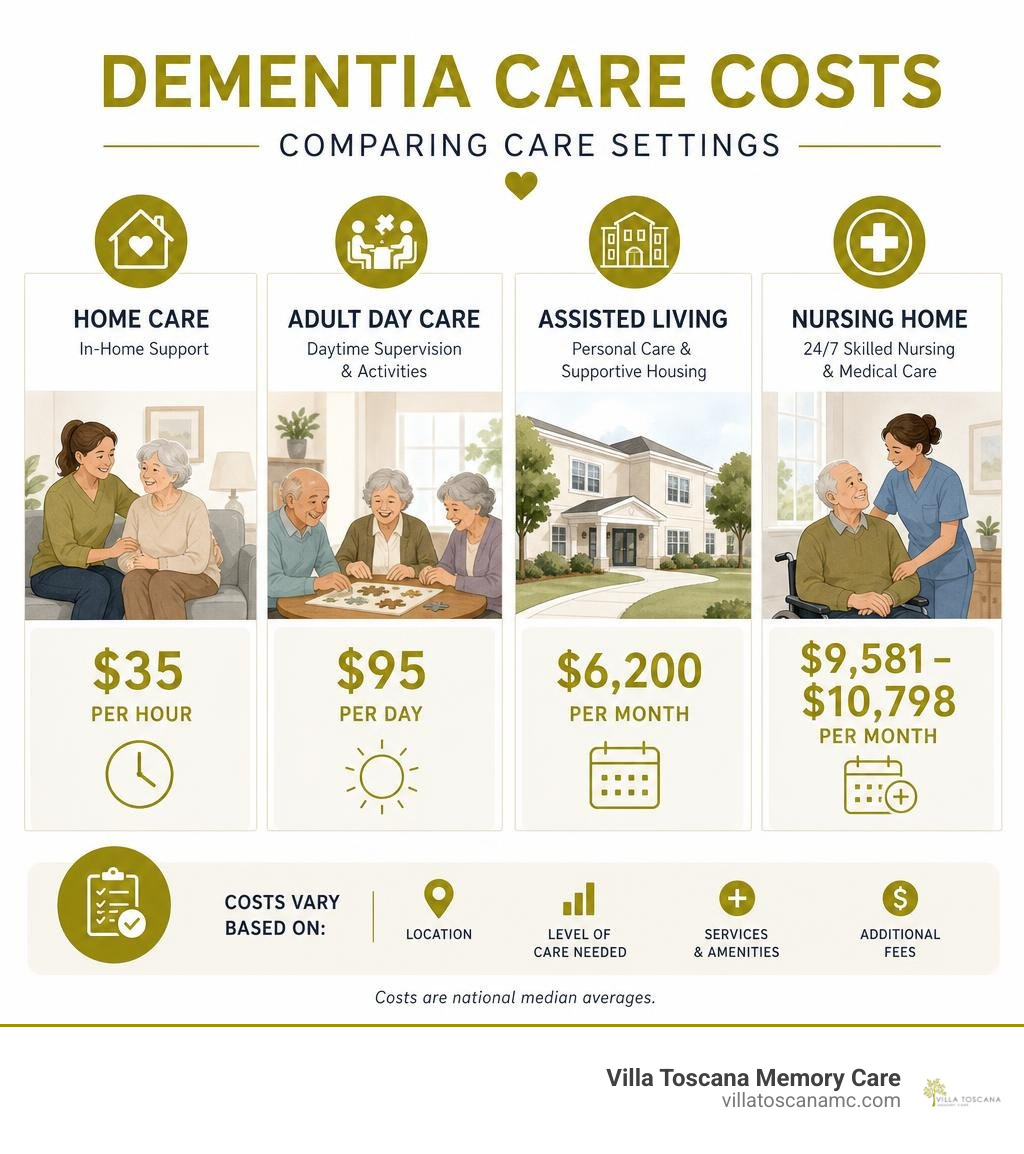
As a national benchmark, 2025 median prices were about:
- $35 per hour for home care
- $95 per day for adult day services
- $6,200 per month for assisted living
- $9,581 to $10,798 per month for a nursing home room
Memory care often costs more than standard assisted living because it includes a secure setting, dementia-trained staff, structured activities, and closer supervision. The final bill also depends on your state, care level, and add-ons such as medication management, supplies, transportation, and move-in fees.
The most important step is to plan before a crisis. Keep separate budgets for medical bills, paid daily care, and the unpaid time family members provide. Medicare can help with eligible medical services, but it generally does not pay for long-term custodial care or a memory care residence.
Understanding the True Dementia Care Cost: National Averages and Settings
When evaluating long-term support for a loved one, the overall dementia care cost depends heavily on the environment and the intensity of supervision required. Dementia is a progressive journey; an individual might begin with a few hours of companion support each week and eventually require round-the-clock specialized behavioral intervention.
To help put these expenses into perspective, the table below outlines national average costs across standard care settings:
| Care Setting | Billing Unit | 2025–2026 Median Cost | Annual Cost Estimate |
|---|---|---|---|
| In-Home Care Aide | Hourly (Part-Time: 20 hrs/wk) | $34 – $35 / hour | $35,360 – $36,400 |
| In-Home Care (24/7) | Hourly / Daily (168 hrs/wk) | $34 / hour | $296,796 |
| Adult Day Services | Daily (Mon–Fri) | $95 / day | ~$24,700 |
| Assisted Living | Monthly Base Rate | $6,200 / month | $74,400 |
| Residential Memory Care | Monthly Base Rate | $6,935 – $7,645 / month | $83,220 – $91,740 |
| Skilled Nursing Facility | Monthly (Semi-Private / Private) | $9,581 – $10,798 / month | $114,975 – $129,575 |
While adult day programs offer affordable daytime respite, they do not resolve evening or overnight safety risks. As cognitive decline progresses, families typically weigh the balance between intensive home health services and dedicated residential options.
In-Home Care vs. Residential Memory Care Settings

Many families initially prefer keeping a parent at home. For light support—such as 15 hours per week of assistance with meal prep or light housekeeping—the monthly outlay hovers around $2,200. However, when behavioral changes, wandering, or severe memory impairment necessitate 24/7 continuous oversight, home care costs explode to nearly $25,000 per month ($296,796 annually).
At that tipping point, residential memory care offers a substantially more predictable and economical alternative. Understanding how memory care compares to skilled nursing helps clarify why pricing structures differ between specialized environments. Skilled nursing centers provide clinical, hospital-grade medical intervention, whereas dedicated memory care communities focus on secured residential spaces, dignified daily assistance, and specialized programming.
Furthermore, attentive care relies on staffing depth. Evaluating memory care staffing ratios and regulations provides peace of mind that your loved one will receive attentive, around-the-clock support without the financial runaway of hiring multiple shifts of private in-home aides.
Geographic Cost Disparities Across the United States and the UK
Where you live dramatically shapes what you will pay. In moderate-cost Midwestern or Southern markets, quality memory care often averages between $5,500 and $6,800 monthly. Conversely, in high-cost metro regions across California, the Northeast, or major metropolitan hubs, monthly rates frequently start between $9,000 and $12,000.
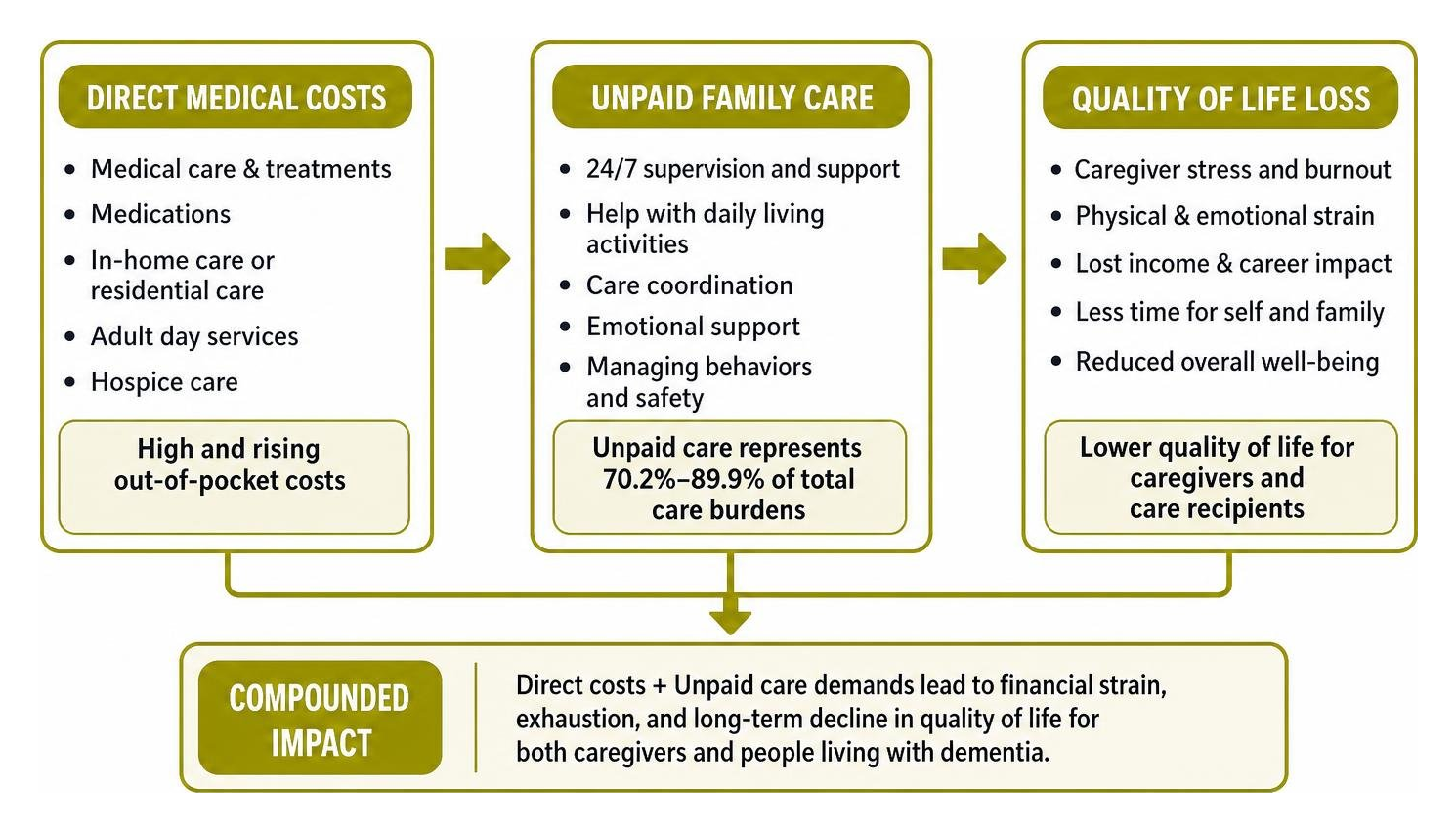
These state-level disparities stem from localized real estate values, mandatory caregiver wage floors, and state-specific regulatory mandates. Research demonstrates that total dementia care costs and informal care reliance vary considerably from state to state, with unpaid family support representing between 70.2% and 89.9% of total care burdens depending on the local infrastructure (Lastuka et al., 2025).
Looking internationally, families in the United Kingdom face similar social care hurdles. In the UK, a person diagnosed with dementia spends an average of £100,000 out-of-pocket over their lifetime, with dementia-specific residential placement running roughly 15% higher than standard elder care. Whether navigating the U.S. private market or the UK social care system, specialized cognitive care commands a premium across the globe.
The Macro View: Direct Spending vs. The Hidden Burden of Unpaid Care
Dementia is retirement’s most financially demanding diagnosis. The economic impact extends far beyond facility base rates and pharmacy bills, quietly siphoning household savings through lost careers, physical exhaustion, and unpaid caregiving hours. Exploring proven paths to relieve caregiver burden is critical for sustaining family wellness.
The $409 Billion vs. $818 Billion Economic Discrepancy
When analyzing the economic burden of dementia, you will often encounter two drastically different national estimates:
- The $409 Billion Projection: As detailed in reports analyzing the 2026 $409 billion projection, this figure accounts for direct, tangible healthcare, long-term residential services, and hospice payments. Public programs (Medicare and Medicaid) foot approximately $263 billion of this tab, while private individuals pay roughly $103 billion out of pocket.
- The $818 Billion Societal Valuation: Comprehensive studies led by institutions like USC expand this model to include indirect societal losses. By quantifying over $320 billion in lost quality of life, $237 billion in unpaid informal caregiving, and tens of billions in lost workplace wages, the total economic footprint doubles.
Families must realize that the estimated lifetime exposure of over $405,000 per person is an economic benchmark that includes unpaid support rather than an itemized commercial invoice. Contextualizing these metrics via analyses of lifetime dementia numbers helps households build realistic budgets.
The Economic Impact of Unpaid Family Caregiving

Across the country, over 12 million family members provide nearly 20 billion hours of uncompensated care annually. Spouses and adult children frequently reduce their working hours, pass up promotions, or take early retirement to handle caregiving duties.
Over 70% of family caregivers report significant emotional strain and sleep deprivation. When family caregivers reach the point of exhaustion, utilizing short-term institutional support can preserve personal health and stability; looking into short-term respite care cost factors can reveal affordable avenues for temporary relief.
Why Medicare Leaves a Coverage Gap for Dementia Care
The single most common misconception among seniors and their families is that Medicare will fund memory care when cognitive decline occurs. In reality, Medicare coverage gaps for dementia leave the overwhelming majority of day-to-day living expenses directly on the family ledger.
What Medicare Covers vs. What Families Pay Out-of-Pocket
Medicare is designed exclusively for acute medical treatment and rehabilitation, not long-term custodial maintenance:
- What Medicare Covers: Medically necessary physician appointments, neurologist evaluations, cognitive screening, prescription medications under Part D, diagnostic MRIs/CT scans, inpatient acute hospital care, and hospice care during end stages.
- The 100-Day Skilled Nursing Limit: Following a qualifying 3-day inpatient hospital stay, Medicare Part A covers skilled rehabilitation up to 100 days. The first 20 days are covered at 100%, but days 21 through 100 require a substantial daily coinsurance copay (exceeding $200/day). Once therapy goals plateau or the 100-day limit expires, coverage ends completely.
- What Families Pay Out-of-Pocket: Medicare pays $0 for ongoing assistance with Activities of Daily Living (ADLs)—such as bathing, dressing, eating, mobility, and incontinence management. It does not pay for room and board in assisted living or residential memory care communities.
The Role of CMS GUIDE and Specialized Support Models
To address systemic gaps, the Centers for Medicare & Medicaid Services introduced the Guiding an Improved Dementia Experience (GUIDE) model. Participating healthcare networks coordinate interdisciplinary care, assign dedicated navigators, and offer eligible participants an annual respite benefit of up to $2,500.
While the GUIDE model does not fund full-time residential living, leveraging the practical benefits of respite care provides essential temporary breaks for primary caregivers navigating the middle to late stages of disease progression.
Uncovering Hidden Fees and Progressive Expenses in Memory Care
When touring residential communities, base monthly rates can sometimes be deceptive. Memory care pricing structures generally account for escalating care needs as cognitive function shifts.
How Disease Progression Impacts Overall Dementia Care Cost
Dementia is not static. As symptoms evolve, staffing requirements and support levels increase:
- Early Stage: Individuals require minimal physical assistance but benefit from structured routines, cognitive engagement, and medication reminders.
- Middle Stage: Behavioral changes, communication challenges, and increased fall risks emerge. Care plans often require specialized behavioral management, such as strategies used when addressing frontotemporal dementia challenges. Daily life thrives best when integrated with therapeutic activities for memory loss.
- Late Stage: Total physical dependence requires two-person transfers, comprehensive continence care, and specialized feeding assistance, elevating monthly care-tier fees.
Hidden Add-On Fees to Watch For on Care Facility Invoices
Before signing a residential agreement, always request a written, line-item fee schedule. Watch out for these common extra costs:
- Community / Move-In Fees: A one-time upfront administrative fee ranging from $1,000 to $5,000.
- Medication Administration: Tiered charges ranging from $200 to over $600 monthly depending on dosage frequency and specialty delivery.
- Continence Supplies: Monthly supply fees (pull-ups, wipes, barrier creams) if not supplied directly by the family.
- Escort & Mobility Services: Surcharges for physically escorting residents to dining halls, activities, or medical appointments.
How to Fund Dementia Care: Public Programs and Private Strategies
Navigating long-term care financing requires proactive planning and a clear understanding of available private assets and government support channels. Insights from expert guides on caring for aging parents with dementia emphasize establishing legal and financial plans early to prevent unnecessary asset depletion.
Public Financial Assistance: Medicaid, VA Benefits, and Social Security
When private funds are limited, public safety nets offer vital support:
- Medicaid & HCBS Waivers: Medicaid covers nursing home stays and, in many states, assists with residential memory care through Home and Community-Based Services (HCBS) waivers. To qualify, applicants must meet strict asset thresholds (often under $2,000 in countable assets).
- Spousal Impoverishment Protections: If one spouse requires memory care while the other remains at home, federal rules allow the “community spouse” to retain a protected share of assets (Community Spouse Resource Allowance, up to $154,140 depending on state limits) and monthly income allowances.
- VA Aid and Attendance: Eligible wartime veterans and surviving spouses can receive substantial monthly pension supplements (often between $1,500 and $2,400+ monthly) to offset the cost of memory care or home aides.
Strategies to Offset Dementia Care Cost Before a Crisis
Families who research memory care pricing benchmarks and savings tips typically combine several proactive financial tools:
- Long-Term Care (LTC) Insurance: Traditional policies or hybrid life/LTC products help cover daily custodial care costs, provided they were secured before any formal cognitive diagnosis or memory loss notation entered medical records.
- Durable Power of Attorney (DPOA): Executing comprehensive legal documents while a parent retains mental capacity allows trusted family members to manage bank accounts, convert assets, or structure trusts without costly probate guardianship proceedings.
- Bridge Loans and Home Equity: Leveraging reverse mortgages, home equity lines, or bridge financing can fund residential transition costs while waiting for a primary residence to sell.
Frequently Asked Questions About Dementia Care Expenses
Does Medicare cover memory care or long-term assisted living?
No. Medicare does not pay for custodial care, memory care room and board, or long-term assisted living. It only covers medically necessary services, doctor visits, acute hospitalization, short-term skilled rehabilitation (up to 100 days post-hospitalization), and hospice.
When does in-home dementia care become more expensive than memory care?
In-home care becomes more expensive than residential memory care when a loved one requires more than 40 to 50 hours of professional home care per week. At $34–$35 per hour, 44 hours of weekly home support equals roughly $6,478 per month, matching the base price of specialized residential memory care. When 24/7 care is necessary, home care costs climb to nearly $25,000 per month.
What is the five-year lookback period for Medicaid long-term care?
The five-year lookback is a rule where state Medicaid agencies review all financial asset transfers made within the 60 months prior to application. If assets were gifted or sold below market value, Medicaid imposes a penalty period of ineligibility calculated by dividing the transferred amount by the state’s average monthly nursing home cost.
Conclusion
Understanding the financial landscape of dementia care allows families to move from reactive crisis management to proactive, compassionate decision-making. By auditing current care needs, understanding Medicare’s boundaries, and planning for progressive care requirements, you can protect both your family’s financial stability and your loved one’s comfort.
At Villa Toscana Memory Care, we believe specialized memory support should pair compassionate, 24-hour care with everyday warmth and transparent living. Our family-owned community offers award-winning architectural safety, engaging daily programs, and exceptional dining in partnership with Giorgio’s Italian Grill. Discover how our dedicated memory care services can provide your family with total peace of mind—schedule a personalized visit today.
Scientific References
Lastuka A, Breshock MR, Taylor KV, Dieleman JL. “The costs of dementia care by US state: Medical spending and the cost of unpaid caregiving..” Journal of Alzheimer’s disease : JAD, 2025. PMCID PMC12231809.